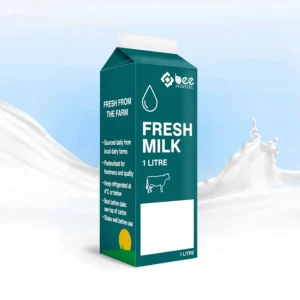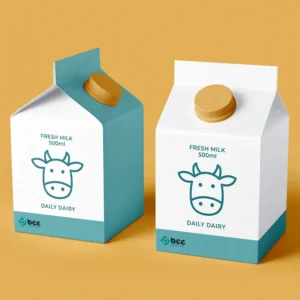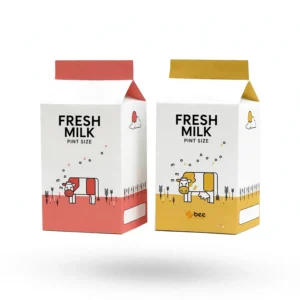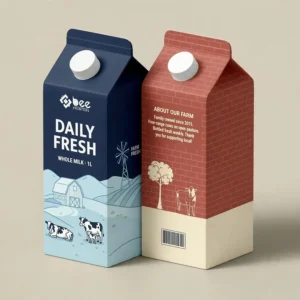
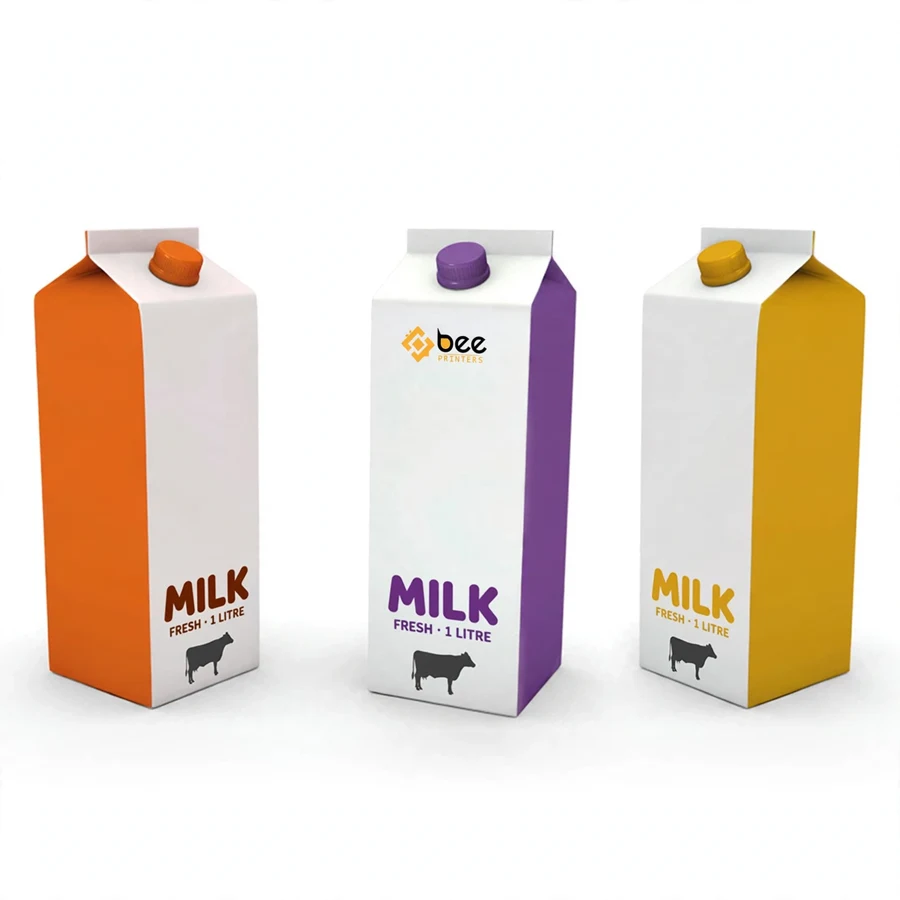
Milk carton packaging is the packaging that most people handle every single day. It holds the milk for breakfast, the juice for lunch, and the cream for coffee, and it does its job so quietly that nobody thinks about it until it fails. A carton that opens cleanly, pours without dripping, and closes again is a small thing that customers notice and remember. At Bee Printers, custom milk carton packaging gives dairy brands, juice makers, and drink producers a gable-top carton printed in full color with their own logo, colors, and message.
The gable-top carton is made from coated paperboard, a thick paper stock that folds cleanly and holds its shape when filled. The top panels fold together into a peaked roof, and the ridge seals shut. The spout is part of that fold: the customer pulls the ridge open, pours, and folds it shut again. It is a simple mechanism with no extra parts, no cap to lose, and no tool needed to open it, which is why it has stayed in use for decades while other packaging has come and gone.
The board used for a milk carton needs to hold up in a cold, damp environment. Milk and juice are stored in fridges, and condensation forms on the outside of the carton. The paperboard is therefore coated so that moisture does not soak in and weaken the walls. The coating also gives the print a clean surface, so brand colors stay bright even in a cold display case. The size is measured from the volume the carton must hold, with the panels cut so the finished carton stands square and stable on the shelf.
Milk carton packaging is the natural choice for fresh milk, flavored milk, cream, and buttermilk. It also suits juices, iced tea, iced coffee, and other chilled drinks that are sold in the same fridge section. Small farms, local dairies, and independent juice brands use it because the shape tells the shopper the product is fresh and everyday. A local dairy in a gable-top carton looks like a local dairy, which is a useful signal when the brand’s whole appeal is freshness and a short journey from farm to fridge.
The shape also works beyond drinks. Dry goods such as popcorn, granola, rice, and pet treats are sometimes packed in gable-top cartons because the shape is easy to open, easy to pour from, and easy to close again. A gable-top carton on a retail shelf stands out from ordinary rectangular boxes, because the peaked top breaks the straight line of the shelf. For a brand that wants its product noticed without changing its product, the carton shape does that work.
For schools, cafes, and catering programs, the gable-top carton is a practical format. It is light, it stacks well, it opens without tools, and it can be printed with a logo, a menu, or a message for the event. The same structure that serves a dairy brand serves a caterer, which is why the shape appears in so many different aisles and settings, from supermarkets to school canteens.
The panels of a gable-top carton give a designer four sides plus the roof to work with. The two wide front and back panels are the natural place for the brand name, the product name, and the main image. The narrow side panels can carry nutrition information, ingredients, a barcode, and contact details. The gable roof itself can carry a short message or a repeated logo, because it is the part of the carton a shopper sees first when looking down into a fridge.
Full-color printing reproduces brand artwork on the carton, and the colors should be chosen with the fridge in mind. A bright color stands out against the white of other cartons and the steel of the fridge shelves. A simple layout usually works best: a bold brand name, a clear product name, and one image or illustration. The product name matters most, because a shopper scanning a fridge needs to find the right carton quickly. Small text should be kept legible and placed on a plain background so it can be read at arm’s length.
Consistency across a range is worth planning. A dairy that sells whole milk, semi-skimmed milk, and chocolate milk in the same carton shape should use the same layout with a different color for each variety, so the shopper learns the system once and finds the right carton every time. The carton becomes part of the brand’s identity, not just a container, and the color code does the work of guiding the choice.
Milk carton packaging comes in a range of sizes, from small single-serve cartons to larger family sizes. The proportions stay the same while the panels grow, which means a brand can offer several sizes in one consistent shape. The base is square, which keeps the carton stable on the shelf and lets it pack tightly in a crate. The ridge is sealed at the top, and the spout opens cleanly when the customer pulls it apart.
Inside, the carton needs no insert. The product is poured straight in and the carton is sealed, which keeps the packing process simple. For dry goods, a sealed inner bag can be added, but for milk and juice the coated board is the container. That simplicity is part of the format’s appeal: fewer parts means fewer things to go wrong, and a lower cost per unit. The carton is filled, sealed, and shipped, with no assembly step at the point of sale.
Wholesale ordering keeps the cost of a printed carton manageable. Cartons are printed and die-cut in large runs, then shipped flat and folded at the filling line, which saves on transport and storage. Ordering in the quantity you actually sell avoids both waste and reordering delays. A proof shows the artwork on the flat carton before production, which is the point where changes are cheap and easy.
Ordering starts with the volume and the quantity. The volume decides the carton size, and the quantity decides the most economical run size. From there, the artwork is prepared: the logo and brand colors are set for print, and the panels are laid out so the brand name, product name, and required information each have their place. A proof shows the flat carton before anything is produced.
The Milk Carton Boxes range covers the whole gable-top family, so if a brand needs a different size or a variation on the shape, the same artwork can be adapted. For brands that need a paper packaging format alongside their cartons, Kraft Paper Bags offer a sturdy printed bag for dry goods and takeaway items. Choosing between a carton and a bag comes down to the product: a carton pours, a bag carries.
Once the proof is approved, production runs to the agreed schedule, and the cartons ship flat for folding at the filling line. Flat-packed cartons save on shipping and storage, and they fold up quickly when needed. Either way, the print arrives sharp and the board arrives clean, ready for filling.
A printed milk carton is built for the fridge, but a few simple habits keep it looking its best. Store flat-packed cartons in a dry place away from direct heat, since damp and heat can mark the board before it is filled. Handle finished cartons by the base where possible, because the printed panels mark more easily than the coated inside. Once filled, the carton should be kept upright and refrigerated, which is how the shape and the seal are designed to work.
When a customer picks up a milk carton, the packaging is part of the daily routine. A carton that opens cleanly, pours without dripping, and closes again is a small thing that customers notice and remember. That is the real return on well-made milk carton packaging: it is not only a container, it is part of the product’s reliability. A well-made carton earns its place in the fridge, on the table, and in the customer’s routine.
| Material | Kraft, Cardboard, Corrugated, Rigid stock |
| Sizes | All custom sizes (any length × width × height) |
| Printing | CMYK / PMS, full-color, offset & digital |
| Finishing | Matte, Gloss, Soft-touch, Foil, Spot UV, Embossing |
| Add-ons | Window cut-outs, inserts, interior printing |
| Minimum Order | 100 boxes |
| Turnaround | 7 to 10 business days after design approval |
| Shipping | Free shipping across the US |