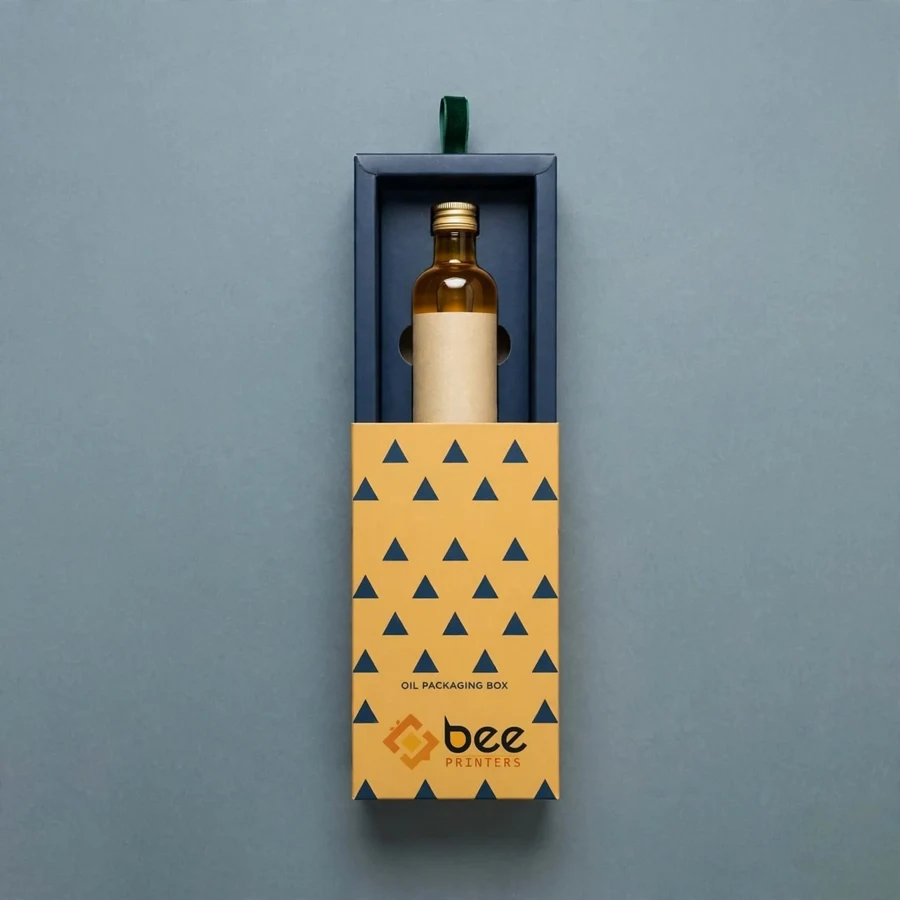
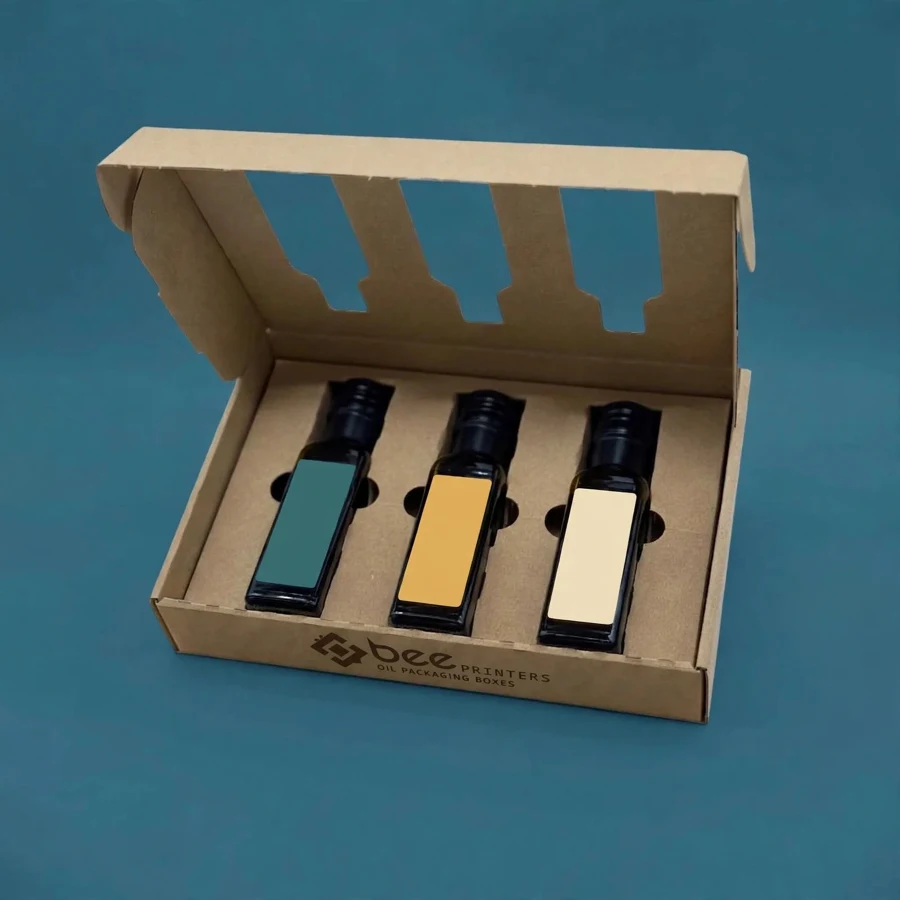
Oil packaging boxes protect small glass and plastic bottles, carry the brand on the shelf, and give the customer the information they need before they buy. A bottle of hair oil or essential oil is fragile, easy to tip over and hard to label fully on its own, so the box does work the bottle cannot do alone. At Bee Printers, custom oil packaging boxes are made to the bottle’s size, printed with the brand artwork, and supplied at wholesale quantities for beauty, essential oil and skincare brands.
Oil bottles come in many sizes, from small 10 ml dropper bottles to larger 100 ml and 200 ml bottles, and each size needs a box that fits it snugly. A box that is too loose lets the bottle rattle and tip, while a box that is too tight is hard to open and risks damaging the label. The box is dimensioned around the actual bottle, including the cap and the dropper, so the bottle sits upright and the box closes cleanly.
A bare bottle on a shelf has very little space for information. The label wraps a small surface, and the text has to be tiny to fit the product name, the ingredients, the directions and the brand. A printed box gives the brand a much larger canvas: the front carries the product name and the logo, the sides carry the ingredients and directions, and the back carries the volume, the batch details and the brand story.
The box also protects the bottle. Glass dropper bottles chip and crack if they knock against each other in transit or on a crowded shelf, and a cardboard box absorbs the knocks that would otherwise reach the glass. A snug box with a fitted insert keeps the bottle upright, so the cap stays sealed and the oil stays inside the bottle instead of leaking into the parcel.
On the shelf, the box is what the customer sees first. A row of matching oil boxes in consistent colors and artwork reads as a range, while a row of bare bottles reads as a collection of loose items. The box turns a small bottle into a shelf presence, and it gives the brand a surface for the design that makes the product recognizable from a distance.
The most common oil box is the straight tuck-end carton: a rectangular box with a tuck flap at the top and the bottom, sized to the bottle. It is economical, easy to assemble, and it prints well on all four sides. It suits single bottles sold at retail, and it stacks neatly in a display or on a shelf.
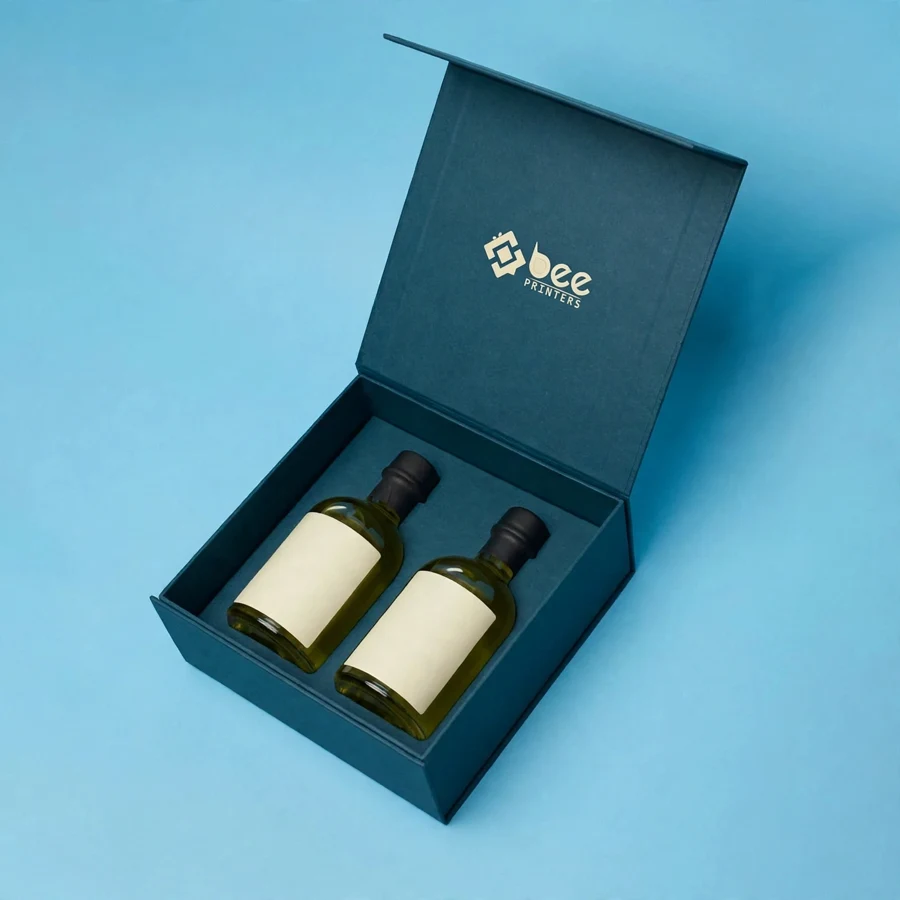
Two-piece rigid boxes suit premium oil ranges and gift sets, where the box is part of the product experience. A rigid lid-and-base box in a matching color, with the logo printed or foiled on the lid, gives the oil a presentation that a folding carton cannot match. Rigid boxes also protect the bottle better, because the thick board resists crushing in transit and in a gift bag.
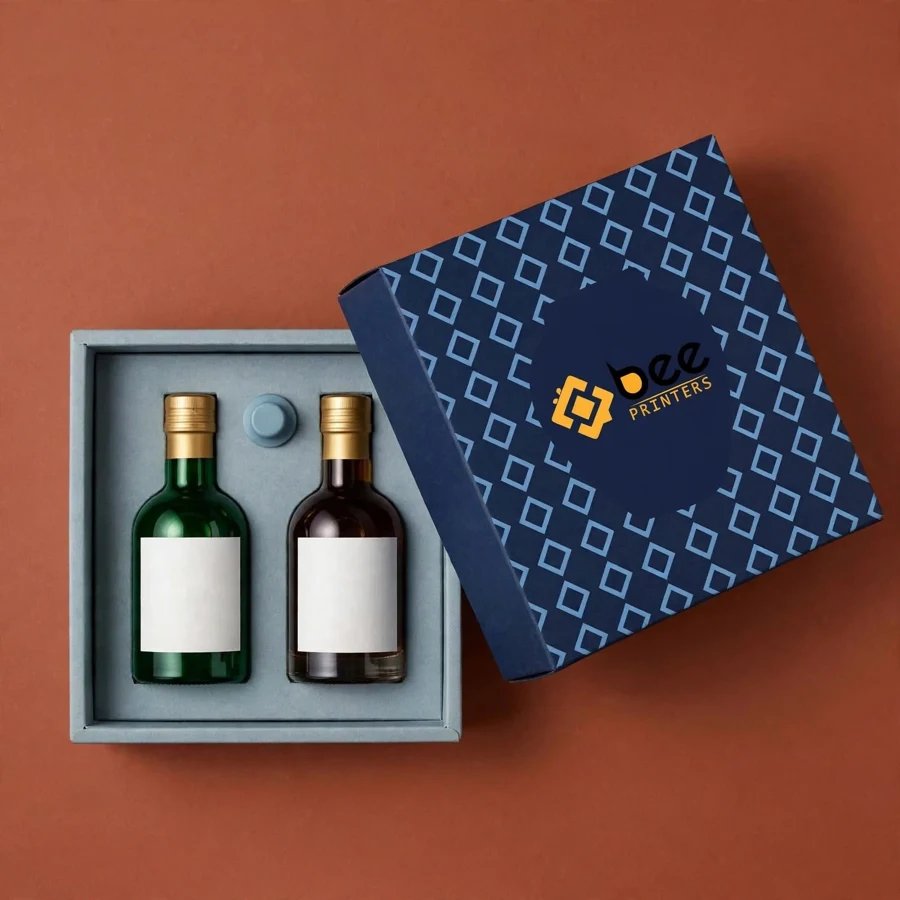
Mailer-style boxes and sleeve boxes cover the other cases. A mailer box protects a single bottle or a small set through shipping, with the brand printed on the outside of the parcel. A sleeve that slides over a plain inner box gives a premium look at a lower cost, because the sleeve carries the artwork and the inner box carries the structure. The style is chosen around how the oil is sold: retail shelf, online order, gift set or subscription box.
Oil boxes are usually made from folding carton board or kraft board, chosen for the weight of the bottle and the finish the brand wants. Folding carton board takes full-color printing cleanly and gives a smooth surface for detailed artwork, while kraft board gives a natural, understated look that suits brands with an earthy or minimal identity. The board weight is matched to the bottle: a small 10 ml bottle needs a lighter board than a tall 200 ml bottle.
Full-color CMYK printing covers the box in the brand colors, the product name, the logo and the label information. The print can run across all sides of the box, including the inside of the lid, where a short message or a pattern can surprise the customer on opening. Matte lamination gives a soft, modern surface and resists fingerprints, while gloss lamination adds shine and makes the colors look deeper.
Finishing options include foil stamping for the logo, embossing for a raised texture, and spot UV for a glossy detail on a matte box. These finishes are used sparingly on oil boxes, because the box is small and a single foil logo or an embossed pattern is enough to lift the design. The finishing is chosen to match the brand: a minimal brand may use a single foil detail, while a bolder brand may use full-color artwork with a gloss finish.
A fitted insert is the simplest way to keep an oil bottle safe inside its box. A cardboard insert with a die-cut hole holds the bottle upright and stops it moving, while a foam insert cradles the bottle more closely and suits heavier glass bottles. The insert is cut to the bottle’s diameter, so the bottle slides in snugly and stays put through handling and shipping.
Closures matter too. A tuck-end box closes with a flap that tucks into the top, which is quick to assemble and easy for the customer to open. A magnetic rigid box closes with hidden magnets and stays shut in a bag, which suits premium oils carried in a handbag or a gift bag. A sleeve box slides open and closed, which gives a clean reveal when the customer pulls the inner box out.
Practical details include a hang tab for retail display, a window cut so the customer can see the bottle color, and a tamper-evident seal for oils sold online. Each detail is a choice, and the choices are made around how the oil is sold and how the customer handles it.
Oil packaging design starts with the product name and the volume, because those are the two things a customer looks for first. The front of the box carries the brand name, the product name and the volume in type large enough to read from a normal shelf distance. The back carries the ingredients, the directions and the brand details in smaller type, where the customer reads them once the box is in hand.
Color carries the range. A brand with several oils can give each oil its own color, so the customer learns to find their oil by the box color, while the layout and the logo stay the same across the range so the products read as a family. A single-oil brand can use one strong color and a clean layout, so the box stands out on a shelf full of busy designs.
The artwork should reflect what is inside the bottle without making claims the product cannot support. Botanical line drawings, simple geometric patterns and clean typography all suit oil packaging, and they print well on both coated and kraft board. The design is kept honest: the box describes the product, the volume and the brand, and it leaves the rest to the product itself.
Oil packaging boxes are ordered by the quantity, the size, the board and the print coverage, and the unit cost falls as the quantity rises. Brands that sell through retail usually order in bulk and keep stock for each oil in the range, so the packaging stays consistent across the shelf. A sample box is the simplest way to check the fit, the print and the feel of the board before committing to a large run.
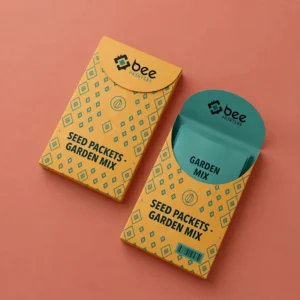
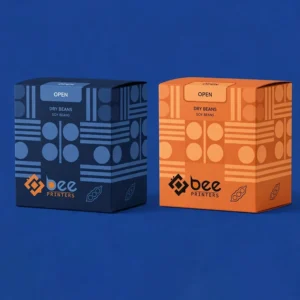
When ordering, it helps to know the bottle dimensions, including the height with the cap and the diameter, the number of bottles per box, the board and finish preferences, and the artwork files. A dieline and a printed proof confirm that the box fits the bottle and the artwork sits where it should before the full run is printed. The wider beauty packaging range is listed in the organic products packaging collection, where oil boxes sit alongside seed and soy bean packaging for comparison.
Brands that want matching cosmetic cartons alongside their oil boxes can look at printed custom cosmetic boxes, another printed carton option from the same supplier for creams, serums and beauty products.
The box is made to the bottle’s height with the cap on and its diameter, plus a small clearance so the bottle slides in easily. Sharing the bottle dimensions is the fastest way to get the right size.
Yes. Cardboard inserts with a die-cut hole and foam inserts are both available, and they keep the bottle upright and stop it moving inside the box.
Folding cartons protect the bottle on a shelf and in a gift bag, while rigid boxes and mailer boxes give stronger protection for shipping. The style is chosen around how the oil is sold.
Yes. All four sides of the box can be printed, so the ingredients, directions, volume and brand details can be carried on the box instead of squeezed onto the bottle label.
Minimums depend on the box style, the size and the print method. Sharing the bottle size and the quantity gives a firm quote and a clear minimum for the chosen style.
| Material | Kraft, Cardboard, Corrugated, Rigid stock |
| Sizes | All custom sizes (any length × width × height) |
| Printing | CMYK / PMS, full-color, offset & digital |
| Finishing | Matte, Gloss, Soft-touch, Foil, Spot UV, Embossing |
| Add-ons | Window cut-outs, inserts, interior printing |
| Minimum Order | 100 boxes |
| Turnaround | 7 to 10 business days after design approval |
| Shipping | Free shipping across the US |