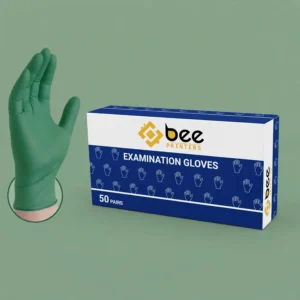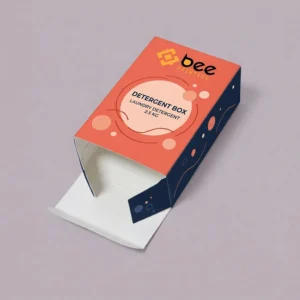
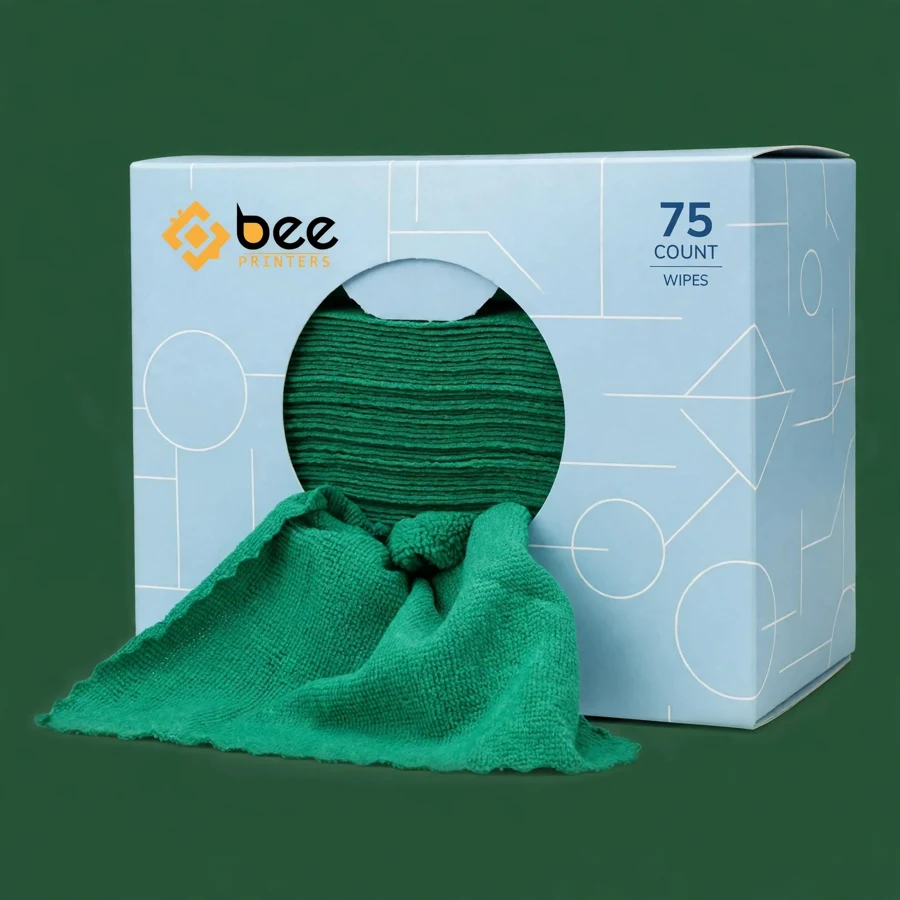
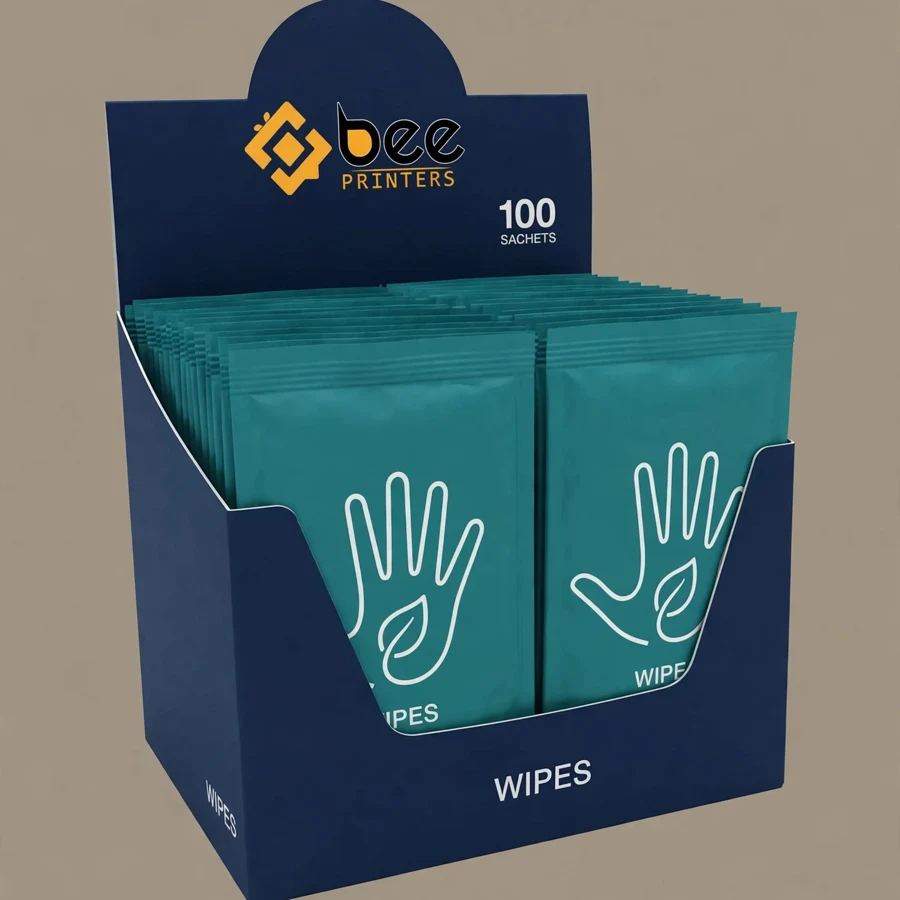
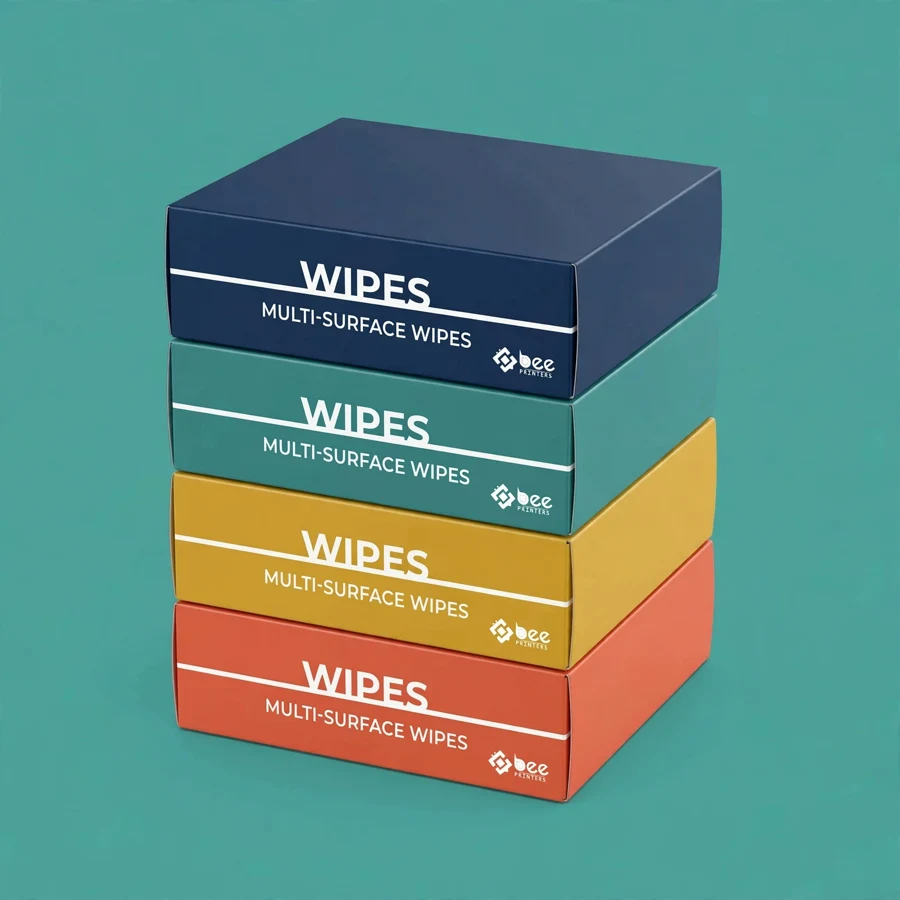
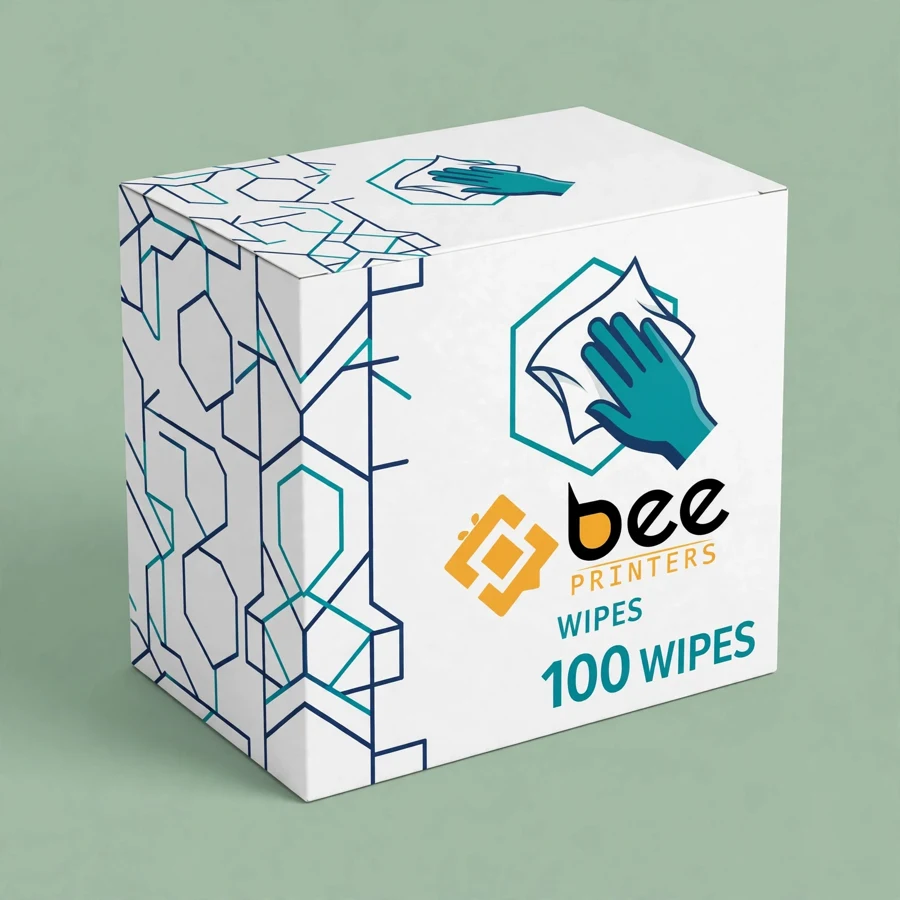
A box of disinfectant wipes is opened many times a day, so its design has to work as a dispenser as well as a package. The opening should let one wipe pull through cleanly, the lid should close again to keep the remaining wipes from drying out, and the box should stay sturdy on a counter or a shelf through weeks of use. At Bee Printers, custom disinfectant wipes boxes are designed around that daily use: a practical dispensing slot, strong board, and clear printed branding that suits retail shelves, offices, and bulk programs alike.
The dispensing opening is the most important detail on the box. A die-cut slot or a shaped opening in the top panel lets the user pull one wipe at a time, and the next wipe should follow far enough to grip easily without pulling a whole handful through. A resealable lid or a close-fitting flap over the opening helps the pack stay fresh between uses. Getting the size and shape of the opening right takes a sample and a real test with the actual wipes, because a slot that is too small tears the wipes and a slot that is too large lets them dry out.
The box structure follows the wipe format. Flat-stack wipes suit a low, wide box with a top opening. Canister-style refills suit a taller box with a side or top slot. Multi-packs suit a larger box with dividers that keep individual packs separate. Whatever the format, the box should hold the inner pack snugly so it cannot shift, and it should close cleanly without forcing or gaping.
Wipes boxes carry a lot of printed information, so the panel layout deserves thought. The front panel holds the brand name, the logo, and the product name in type that reads at shelf distance. The side panels are the natural place for the wipe count, the pack size, and a short description of the product. The back panel can hold longer text, such as directions for use, storage notes, a barcode, and contact information. A clear hierarchy keeps the box readable instead of crowded.
Full-color CMYK printing reproduces brand artwork faithfully, whether the design is a clean clinical blue and white or a bold, high-contrast retail look. A gloss finish makes colors look richer and adds a layer of surface protection against scuffs and moisture in storage. A matte finish gives a calmer, more understated feel. The artwork is checked before printing so that fine lines, small type, and logo details reproduce cleanly across the whole run.
Small type needs care on a wipes box because the back panel often carries detailed text. The typeface should stay legible at the printed size, and the contrast between text and background should be strong enough to read easily under store or office lighting. A proof stage is the time to check spelling, spacing, and alignment, along with the position of the barcode. Once the proof is approved, the artwork is kept on file so repeat orders print the same way every time.
Cardboard is the standard material for wipes boxes because it prints well, folds cleanly, and holds a die-cut dispensing slot accurately. A thicker board adds crush resistance, which matters for a box that sits on a busy counter or in a cleaning cupboard and gets picked up and put down many times a day. Kraft board gives a natural, earthy look and pairs well with simple printing, while a coated board gives a smoother printed surface and better resistance to light moisture.
Coatings protect the print and change the feel of the box. A gloss lamination adds shine, deepens colors, and resists scuffs. A matte lamination gives a soft, fingerprint-resistant surface. An aqueous coating is a lighter option that protects the print during handling without changing the look much. For brands that want a lower-impact approach, recycled board is available and performs the same as virgin board at the same thickness, and the board choice can be described on the box in plain words about the material used.
The lid or flap over the dispensing opening deserves the same attention as the rest of the box. A resealable adhesive label can be applied over the slot, and a hinged cardboard flap can be built into the box structure itself. Either way, the closure should open and close many times without tearing or losing its grip, because a lid that stops working halfway through the pack is the detail customers remember.
Retail shelves suit a compact box that stands upright and shows the front panel to the customer. Offices, clinics, and schools often buy larger packs or multi-packs, which suit a wider box with a clear wipe count and a sturdy handle or a reinforced base for carrying. Bulk programs suit a plain, strong outer carton with the printed retail boxes packed inside, so the same printed design serves both the shelf and the storeroom. Choosing the style for the channel keeps the packaging practical.
Counter displays are another option worth considering. A small display box that holds several retail packs upright makes the product easy to find and easy to restock, and it gives the brand more printed space at the point of sale. A window cut-out on the front of the box lets the customer see the inner pack without opening it, and it should be planned into the artwork from the start rather than added as an afterthought.
Sizes are cut to order, from small single packs to large bulk quantities. Standard sizes keep costs down for common wipe formats, while custom sizes suit a brand with a distinctive pack shape or a presentation idea that needs an exact fit. Measuring from the real inner pack, including any seal or closure, is the step that makes the finished box close cleanly.
Wipes brands usually order boxes in the hundreds or thousands, and wholesale quantities bring the per-box cost down. Larger runs spread the setup cost across more units, so the price per box falls as the quantity rises. Small runs are still possible for a new product launch or a limited edition, letting a brand test a design on the shelf before committing to a larger order. Boxes arrive flat-packed and ready to assemble, which keeps storage simple and shipping costs reasonable.
Planning an order starts with four decisions: the box style, the size, the board, and the artwork, plus the shape of the dispensing opening. Once those are settled, a sample can be produced so the brand can check the fit, the dispensing action, the feel of the board, and the print quality before the full run. Sampling is worth the small delay it adds, because it is the last easy chance to change anything, and testing the sample with the real wipes is the surest way to confirm the slot works. After approval, the full run is printed, cut, folded, and packed for delivery.
Brands that sell more than one wipes product often order one design in several sizes, so the single pack, the multi-pack, and the bulk pack all share the same artwork. This keeps the brand consistent and simplifies reordering, since the artwork file stays the same and only the dimensions change. Over time, a brand can build a small family of boxes that customers recognize at a glance.
For brands building out a full hygiene and household range, the hygiene products packaging collection brings together the box styles that suit this market, so a whole range can be planned in one place. And for a related look at printed boxes for a similar household product, the window soap boxes show how a die-cut window and bold, full-color print work together on the shelf. Both pages give a useful starting point for planning a wipes box that fits the product, the brand, and the way it is sold.
| Material | Kraft, Cardboard, Corrugated, Rigid stock |
| Sizes | All custom sizes (any length × width × height) |
| Printing | CMYK / PMS, full-color, offset & digital |
| Finishing | Matte, Gloss, Soft-touch, Foil, Spot UV, Embossing |
| Add-ons | Window cut-outs, inserts, interior printing |
| Minimum Order | 100 boxes |
| Turnaround | 7 to 10 business days after design approval |
| Shipping | Free shipping across the US |