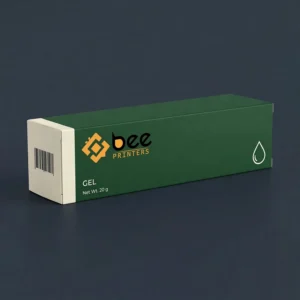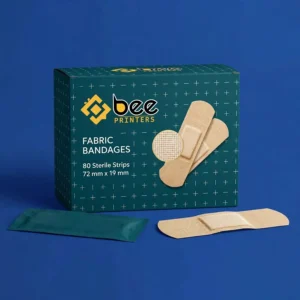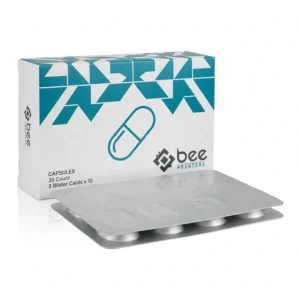


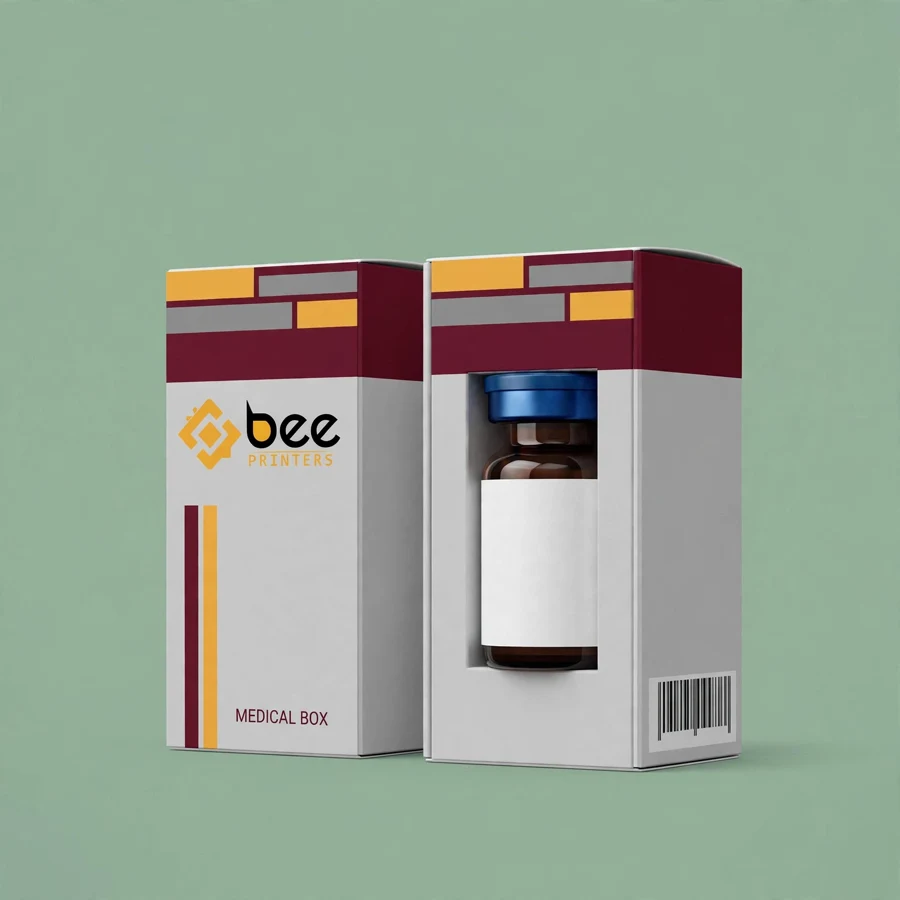
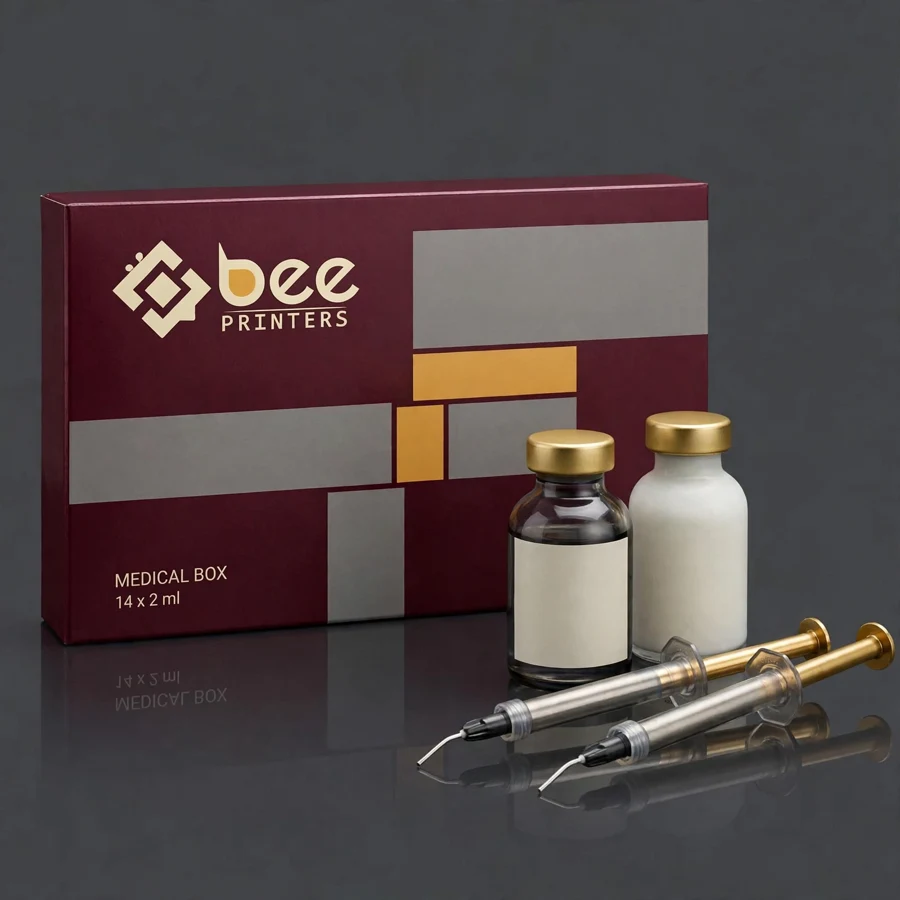
Medical boxes cover a broad range of products: small devices, diagnostic items, and pharma products that need a sturdy, clearly labelled carton. The box has to do several jobs at once: hold the product securely, carry clear information on every panel, and look professional on a pharmacy or clinic shelf. At Bee Printers, medical boxes are printed on sturdy board in custom sizes, so the carton fits the product inside instead of the product having to fit a standard box.
A medical product is often handled by several people before it reaches the end user: packers, shippers, pharmacists, and clinic staff. The carton needs to survive that journey without crushing, tearing, or losing its shape, and it needs to open cleanly when the time comes. A well-made medical box is one that arrives looking as neat as it did when it left the packing line.
Medical boxes come in many sizes, from small cartons for compact devices to larger boxes for kits with several parts. Tuck-end cartons are the standard structure for most medical products: they fold up quickly, close neatly, and can be opened and closed again without falling apart. For heavier items, a stiffer board and a reinforced base keep the box rigid under the weight of its contents.
Where a product has several parts, a divider or an insert can keep each part in its own place inside the box. That stops parts from knocking together in transit and makes the contents easy to find when the box is opened. The insert is cut to the shape of your product, and the box is sized around it, so everything sits snugly with no wasted space.
Medical boxes are printed on folding carton board chosen for stiffness and a clean print surface. Heavier board is used for larger or heavier products, while lighter board suits small, light cartons. Full-colour printing reproduces brand colours, logos, and small text sharply, which matters when a box carries detailed information on every panel.
Matte lamination gives medical packaging a clean, professional finish and keeps the surface free of fingerprints, while gloss lamination makes colours look brighter. A soft-touch finish is available for brands that want a premium feel. Spot gloss can highlight a logo or a single line of text, and foil can pick out a brand mark without overwhelming the design.
The front panel of a medical box carries the brand name and the product name, and both need to be readable at a glance. Clear typography and a layout that does not crowd the panel are essential, because customers and staff compare products side by side and reach for the one they can understand fastest. Your logo and colours are printed as supplied, and the design is checked at actual size before printing.
The side and back panels carry the rest of the information: contents, directions, batch details, and any other text the brand needs to show. Because the box is printed on all sides, that information can be laid out in a logical order instead of being squeezed into a corner. The result is a carton that looks organised and professional from every angle.
A cardboard insert can hold a device in place, keep a bottle upright, or separate the parts of a kit so they do not move in transit. Inserts are cut to your product, and they add very little to the cost of the box while making the contents noticeably tidier when the box is opened.
Tamper-evident features are available as packaging options for medical boxes. A seal sticker across the tuck flap shows at a glance whether the box has been opened, and a glued tuck flap gives a firmer close that resists accidental opening in a bag or on a shelf. These are packaging features: they show the carton has stayed closed since packing, and they give retailers, staff, and customers a clear, visible sign that the box is intact.
A medical box order starts with the product itself: its measurements, its weight, and how many parts it has. Those three facts decide the size of the carton, the weight of the board, and whether an insert or a divider is needed. A light, single-part product fits a standard folding carton, while a heavier product or a kit with several parts needs a stiffer board and an insert that keeps everything in place. Getting these details right at the start saves time later, because a box that fits well packs faster and travels better.
Quantities are the next decision. A smaller first run is a sensible way to check the fit, the print, and the way the box behaves on the packing line before ordering in larger numbers. Repeat orders can then be placed in the same specification, so the box stays consistent from one batch to the next. A proof is prepared before printing so the size, the layout, and the text can all be checked before the full run is produced.
Medical boxes are ordered in wholesale quantities, and the price per box comes down as the quantity goes up. Custom sizes, board weights, printing, inserts, and finishes are all included in the quote, so the price you see covers the finished box as specified. A smaller first run lets you check the fit and the print before committing to a larger order, and repeat orders can be placed in the same size and specification.
To start an order, share the measurements of your product, the quantity you need, and your artwork or logo files. A proof is prepared before printing so you can check the layout, the colours, and the text. Once the proof is signed off, the boxes are printed, die-cut, folded, and shipped ready to pack. Browse the full range in our pharmaceutical packaging collection, and for a related medicine carton, see our Custom Medicine Box.
| Material | Kraft, Cardboard, Corrugated, Rigid stock |
| Sizes | All custom sizes (any length × width × height) |
| Printing | CMYK / PMS, full-color, offset & digital |
| Finishing | Matte, Gloss, Soft-touch, Foil, Spot UV, Embossing |
| Add-ons | Window cut-outs, inserts, interior printing |
| Minimum Order | 100 boxes |
| Turnaround | 7 to 10 business days after design approval |
| Shipping | Free shipping across the US |