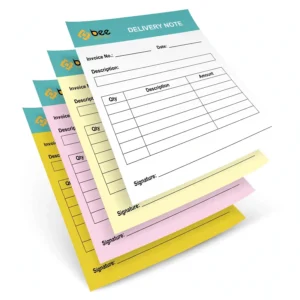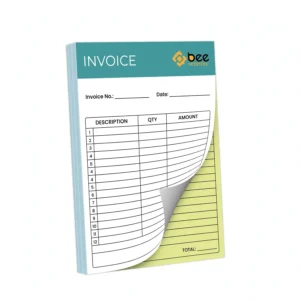
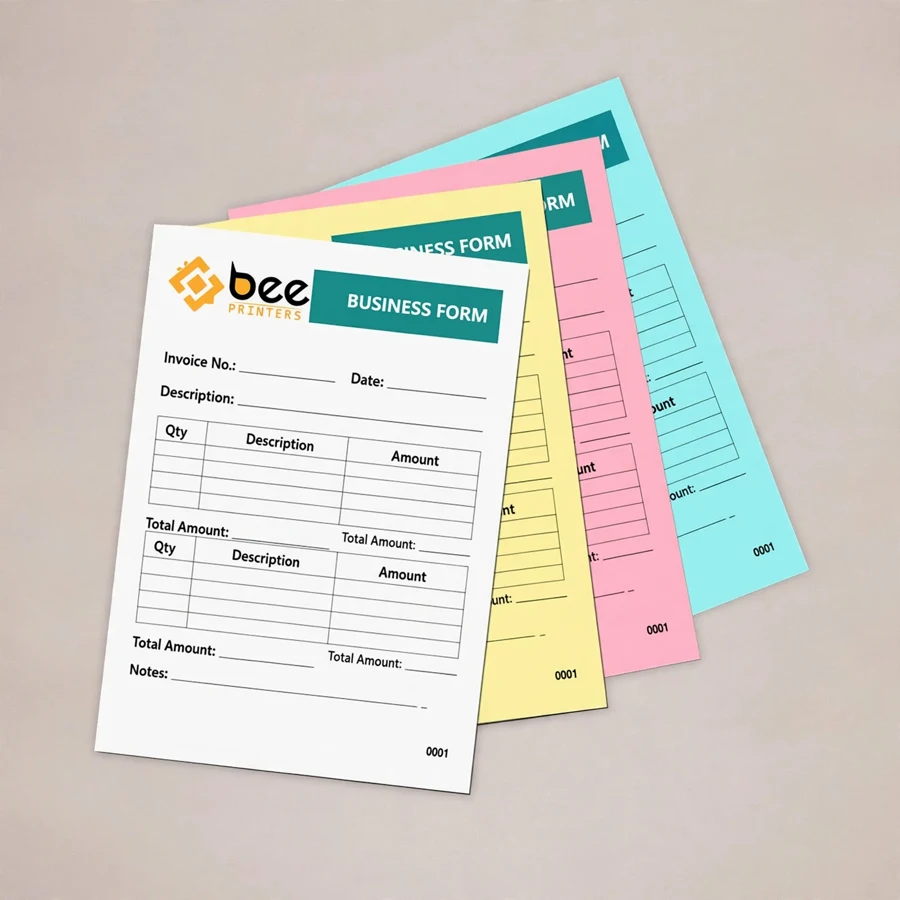
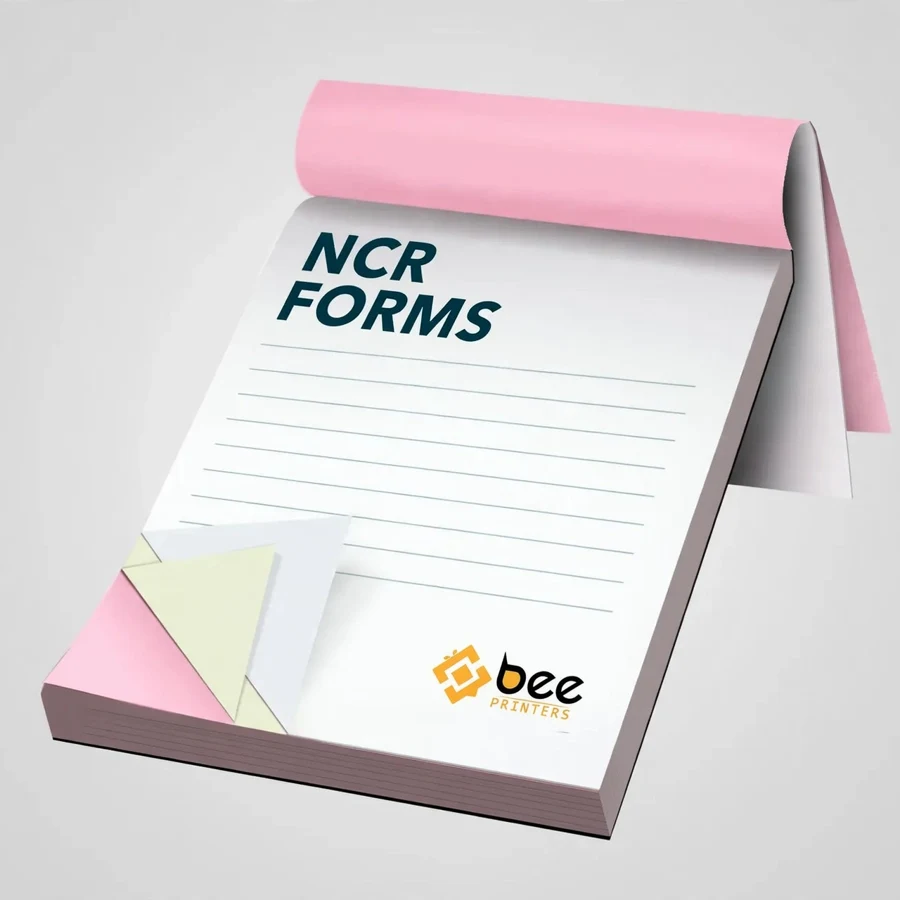
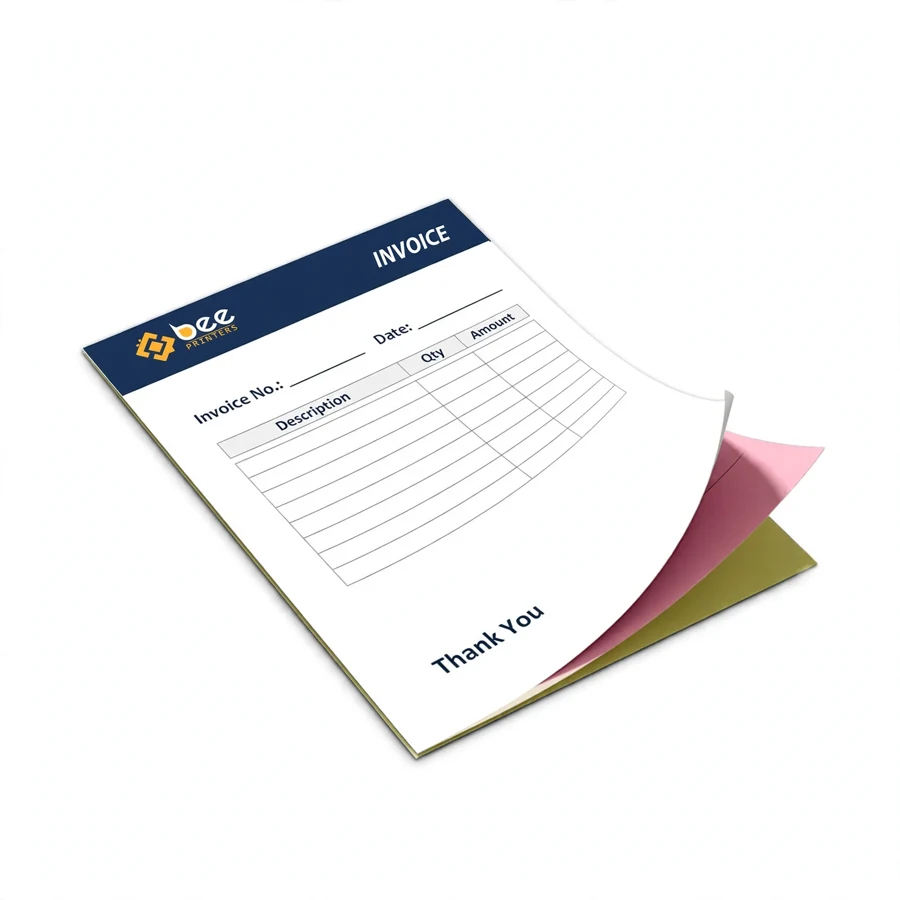
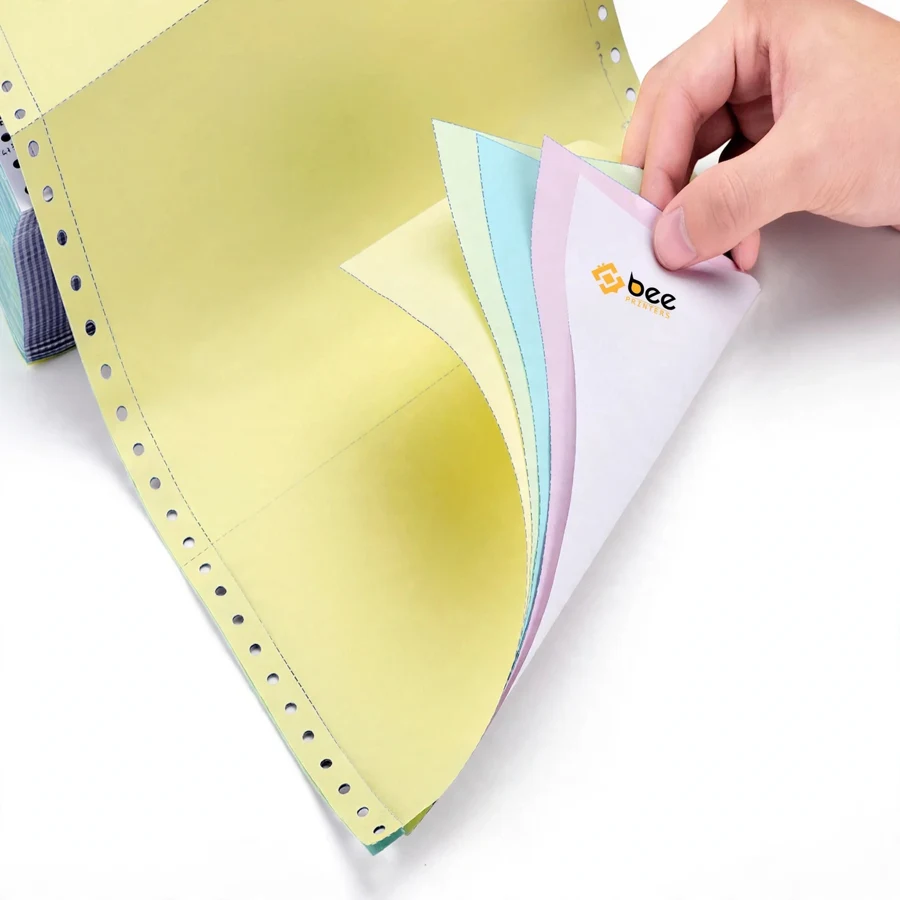
NCR printing turns blank carbonless paper into finished business forms: invoices, receipts, delivery notes, work orders and order books printed with your business details, your layout and your numbering, ready to write on. At Bee Printers, NCR printing covers custom carbonless books in 2, 3 or 4-part sets, in loose sheets, pads or bound books, so the forms arrive ready for the counter, the van or the site.
NCR stands for “no carbon required”. The paper carries a coating of microscopic capsules that break under the pressure of a pen and transfer the writing to the sheets beneath, so one entry produces matching copies on every part of the set. Printed NCR forms add the business identity to that mechanism: the logo, the address, the form fields and the sequential numbers are printed in the same position on every part, so each copy is a complete branded document.
Invoices are the most common NCR print job. A printed invoice form carries the business name, logo, address, phone and registration details at the top, a customer address block, an itemized table, a totals section, payment terms and a signature line, all printed in matching positions on every part. The business keeps the original, the customer takes a copy, and a third copy can travel with the goods or sit in the delivery file.
Receipt books are the compact version of the same idea. A printed receipt carries the business details and a space for the amount, the date and the signature, and the customer copy serves as proof of payment while the retained copies support the daily takings record. Delivery notes rely on NCR printing because the customer signs the top sheet and the signature transfers to every part, so the signed copy, the customer copy and the office copy all show the same signature and the same delivery details.
Work orders, order forms, quotations, credit notes, inspection reports and service agreements are all printed the same way. Each form is designed around the information it must capture, with fields, tables and check boxes laid out so the writing fits and the copies stay legible. A well-designed NCR form is easy to fill in, easy to read and easy to file, which is the whole point of printing it properly in the first place.
The number of parts in an NCR book decides how many copies one entry produces. A two-part book has a white top sheet and a colored second sheet, usually canary yellow, and it covers the simple case: one copy for the business and one for the customer. A three-part book adds a pink bottom sheet, giving a third copy for a driver, a workshop, an accounts department or a head office.
A four-part book adds a fourth copy for longer chains, such as a supplier, a transporter, a customer and an office all needing the same signed record. The coating sequence is the same in every case: the top sheet is coated on the back, the middle sheets are coated on both sides, and the bottom sheet is coated on the front, so the image passes down through the set until the final sheet stops it.
The standard color sequence is white on top, canary in the middle and pink at the bottom, and it helps everyone in the workflow tell the copies apart at a glance. Other color combinations can be arranged, and the top sheet is normally kept white so the original looks clean in the file. The part count is chosen by mapping who needs a copy, and it is worth getting right before printing, because a book printed with too few parts forces someone to photocopy every form.
A good NCR form starts with the writing. The fields should be wide enough for the information they hold, the lines should be spaced so handwriting does not crowd, and the most-used fields should sit where the hand naturally falls. An invoice that is hard to write on produces copies that are hard to read, so the layout is designed around the person filling it in, not around the logo.
The printed layout must also line up across every part. Form fields, tables and lines are printed in the same position on the white, canary and pink sheets, so the writing falls in the same place on each copy. A form where the lines drift between parts is a form where the writing lands on the wrong line by the third copy, which is why the print registration matters as much as the design.
Sequential numbering is the most valuable feature on a printed NCR book. Each set carries the next number in the sequence on every part, which makes it easy to spot a missing invoice, match a customer copy back to the office file, and keep the accounts in order. Numbering can start at any number the business chooses, so a switch to printed NCR books can continue an existing invoice sequence without a break. Other useful features include a perforation so the customer copy tears away cleanly, terms and conditions on the reverse of the bottom sheet, and a colored header band that carries the brand.
Printed NCR forms are supplied in three formats, and the format is chosen around where the forms are filled in. Bound books have a wraparound cover, often with the business name printed on it, and they suit vans, site bags and field work, where the forms need protection and the sets need to stay in order. A book also keeps the numbering sequence intact, because the sets are used in order and a missing set is obvious.
Glued pads have a stiff backing board that gives a firm writing surface, and they suit a desk or a counter where the forms are filled in standing up. The top set tears away when it is complete, and the pad stays put for the next one. Loose sets suit businesses that feed the forms through an impact printer, where the printer strikes the set and the copies come out ready to separate.
The cover and the backing board are part of the print job too. A book cover can carry the business name, logo and a space for the date range, so a shelf of finished books is easy to search. A pad backing can carry a quick reference, such as the price list or the terms, where the person filling in the form can see it.
Good NCR printing starts with good carbonless paper. The coating must transfer a sharp, readable image to every part of the set, including the bottom copy of a four-part book. A sample book is the simplest way to check the transfer quality, the feel of the paper and the alignment of the printed layout before committing to a large run.
Writing pressure matters as much as the coating. A firm ballpoint pen and a hard surface underneath the book give the sharpest copies, and the stiff backing board on a pad or the cover of a book helps the pressure reach the bottom sheet. A soft pen, a light touch or a padded surface absorbs the pressure before it reaches the last copy, which is the most common reason for a faint bottom sheet.
Paper weight is a balance. Lighter sheets transfer more easily and keep a thick book slim, while heavier sheets feel more substantial and stand up better to handling and filing. The right weight depends on how the books are used: a delivery book that lives in a van benefits from tougher sheets, while a desk pad used indoors can use a lighter weight. Storage is simple: keep the books flat, dry and away from heat so the coating stays active.
NCR printing is priced by the quantity, the number of parts, the size and the format, and the unit cost falls as the quantity rises. Businesses that issue forms every day usually order in bulk and keep stock at each counter, van and site, so nobody runs out mid-shift. Bulk ordering also keeps the printed layout and the numbering sequence identical across the whole run, which matters when the forms carry the brand.
When ordering, it helps to have the form layout, the number of parts, the quantity of books or pads, the sheet size, and the starting number for the sequence. A proof of the layout confirms that the fields, the logo and the numbering sit where they should before the full run is printed. The wider carbonless range, including plain sheets and other part counts, is listed in the NCR paper collection, so the printed options can be compared with the unprinted ones in one place.
Businesses that post their NCR books or pair them with mailing supplies can also look at custom mylar envelopes, another packaging product available from the same supplier for protecting documents and products in transit.
NCR printing is the printing of business forms on carbonless paper, so one handwritten entry produces matching copies on every part of the set. The printed form carries the business details, the layout and the numbering.
Two-part, three-part and four-part books are standard. Two parts cover the business and the customer, three parts add a copy for a driver or a department, and four parts cover longer chains.
Yes. Business details, logos, form fields, sequential numbering, perforation and terms can all be printed on NCR books, with the layout matched across every part.
Books suit mobile work, because the cover protects the sets and keeps them in order. Pads suit a desk or counter, because the backing board gives a firm writing surface and the finished set tears away.
No. Laser printers use heat, which can affect the coating. NCR paper is designed for handwriting with a ballpoint pen and for impact dot-matrix printers.
| Material | Kraft, Cardboard, Corrugated, Rigid stock |
| Sizes | All custom sizes (any length × width × height) |
| Printing | CMYK / PMS, full-color, offset & digital |
| Finishing | Matte, Gloss, Soft-touch, Foil, Spot UV, Embossing |
| Add-ons | Window cut-outs, inserts, interior printing |
| Minimum Order | 100 boxes |
| Turnaround | 7 to 10 business days after design approval |
| Shipping | Free shipping across the US |