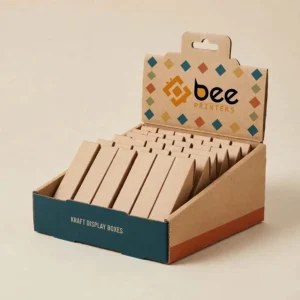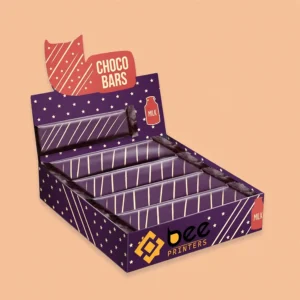
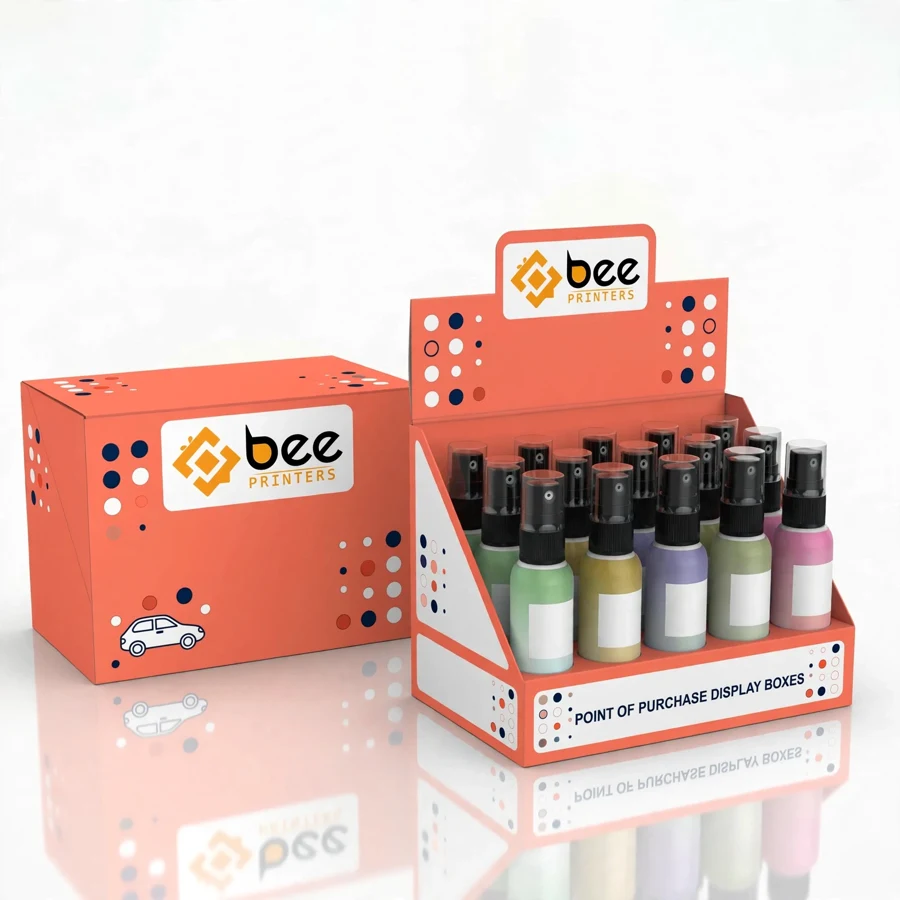
A point of purchase display box, often called a POP display box, is a custom printed box placed exactly where a customer makes a buying decision: beside the till, at the end of an aisle, or on a counter near the entrance. Unlike packaging that sits quietly on a distant shelf, a point of purchase display works in the final seconds before a sale, catching the eye, presenting the product clearly and giving the shopper a reason to pick it up. The box holds the product upright and visible, carries the brand logo and a short message, and makes it easy for the customer to take one. At Bee Printers, each point of purchase display box is printed with the customer’s own artwork and built to the size of the product it holds, so the display looks made for the shop rather than borrowed from somewhere else.
Most buying decisions in a shop happen quickly, and many happen on impulse. A customer who came in for one thing will often add a small item at the till if it looks appealing and is easy to reach. That is the moment a point of purchase display is built for. Placed at eye level and within arm’s reach, the display puts the product in front of people who were not looking for it a minute earlier. The box itself does the selling: the product is visible, the price or offer is clear, and there is nothing between the shopper and the item. For small, affordable products such as snacks, cosmetics, phone accessories and gift items, this kind of display can move more units in a week than a shelf position at the back of the shop. It is one of the simplest and most direct forms of in-store marketing a brand can use.
Point of purchase displays come in several forms, and the right one depends on the product and the space available. Counter display boxes are the most common: compact boxes that sit beside a till or on a service counter, holding a dozen or so units where customers wait. Shelf trays and end-cap displays work for larger quantities, while dump bins hold loose or bagged items that customers can pick through. Some displays have a tall header card that rises above the products and carries the brand name where it can be seen across the shop. Others are designed as self-contained floor stands that can be placed near an entrance or beside a related product. The structure is always chosen around the same questions: how big is the product, how many units need to be on show, and how much space does the shop have to spare.
A point of purchase display has only a few seconds to win a shopper’s attention, so its design must be direct. A clear brand name, one strong colour and a short message usually work better than a crowded layout, because the customer reads the display while walking or waiting rather than studying it. The product itself should be visible, either through an open front or a die-cut window, so the shopper can see what they are buying without opening anything. Bright colours, bold lettering and a clean layout help the display stand out among the other boxes and signs in a busy shop. The message on the box should say what the product is and why it is worth picking up, in as few words as possible. A display that tries to say too much often says nothing at all, because the shopper has already moved on.
Every point of purchase display box is made to fit the product it holds, and the dimensions are worked out from the product’s size, weight and the number of units per display. A box for small sachets will be shallow with a low front so the contents are easy to see, while a box for bottles or jars needs deeper walls and a stronger base to hold the weight. Inserts and dividers keep products standing in neat rows instead of falling over or sliding together, which keeps the display looking full and tidy even as items are sold. Locking tabs and glued bases are chosen for strength, since a display box is handled many times a day by staff and customers. The boxes ship flat, fold up quickly, and can be refilled from the back or the top, so shop staff can keep the display stocked without taking it apart.
A point of purchase display lives in the busiest part of a shop, so it needs to be tougher than ordinary packaging. Sturdy cardboard in a suitable thickness holds its shape through weeks of handling, and a good print finish resists scuffs and fingerprints. Full-colour printing gives the brand freedom to use photographs, illustrations and bold colour blocks, while a matte or gloss lamination protects the surface and keeps the colours looking fresh. Some brands choose kraft board for a natural look, while others use white board so their colours print at their brightest. The full range of custom display boxes covers these material choices, and the right one depends on the product, the shop and the image the brand wants to present. Whatever the material, the print quality matters, because a faded or scuffed display reflects badly on the product it holds.
Point of purchase displays work in almost any shop, but they are most effective where customers pause or queue. Supermarkets and convenience stores use them at checkouts for snacks, drinks and small household items. Pharmacies place them beside the till for vitamins, lip balms and travel-size products. Gift shops and bookshops use counter displays for small keepsakes, cards and stationery. Electronics shops use them for accessories such as cables, cases and chargers, and beauty counters use them for trial sizes and new launches. Seasonal promotions are another strong use: a display built for a holiday, a new flavour or a limited edition gives shoppers a reason to notice a product they might otherwise walk past. In each case the display turns a quiet corner of the shop into a selling space.
Ordering a point of purchase display starts with the product and the place it will stand. The size and weight of the product decide the box dimensions and board thickness, and the shop layout decides whether a counter box, a shelf tray or a floor display is the right fit. Artwork is prepared with the display’s viewing distance in mind, so the brand name and message stay readable from a few steps away. Brands can order in wholesale quantities for a single store, a chain of shops or a seasonal promotion, and repeat orders can be printed from the same artwork so the display looks the same in every location. Because the boxes ship flat, they are easy to send to different shops and quick for staff to assemble. A quote is the simplest way to compare structures, materials and print options before committing to a design.
A point of purchase display box is a small piece of packaging with a large responsibility: it has to attract attention, present the product, carry the brand and close the sale, all in a few seconds and in the busiest part of the shop. When it is designed well, with the right size, the right structure and clear, honest artwork, it becomes one of the hardest-working items in a brand’s marketing. It costs far less than a full advertising campaign, yet it speaks directly to the customer at the exact moment they are ready to buy. For brands that want a display built for the wider shop floor rather than the till point, retail display boxes offer larger formats for shelves and promotional areas. Either way, the principle is the same: put the product where the customer can see it, make it easy to pick up, and let the packaging do the talking.
| Material | Kraft, Cardboard, Corrugated, Rigid stock |
| Sizes | All custom sizes (any length × width × height) |
| Printing | CMYK / PMS, full-color, offset & digital |
| Finishing | Matte, Gloss, Soft-touch, Foil, Spot UV, Embossing |
| Add-ons | Window cut-outs, inserts, interior printing |
| Minimum Order | 100 boxes |
| Turnaround | 7 to 10 business days after design approval |
| Shipping | Free shipping across the US |