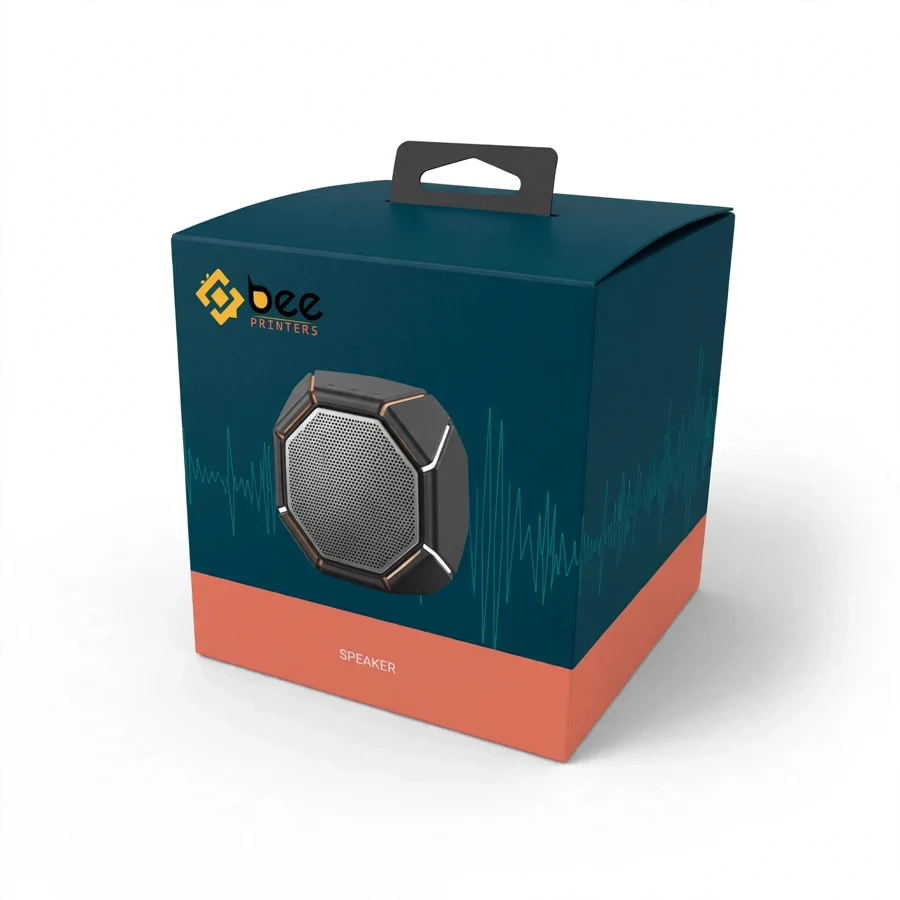
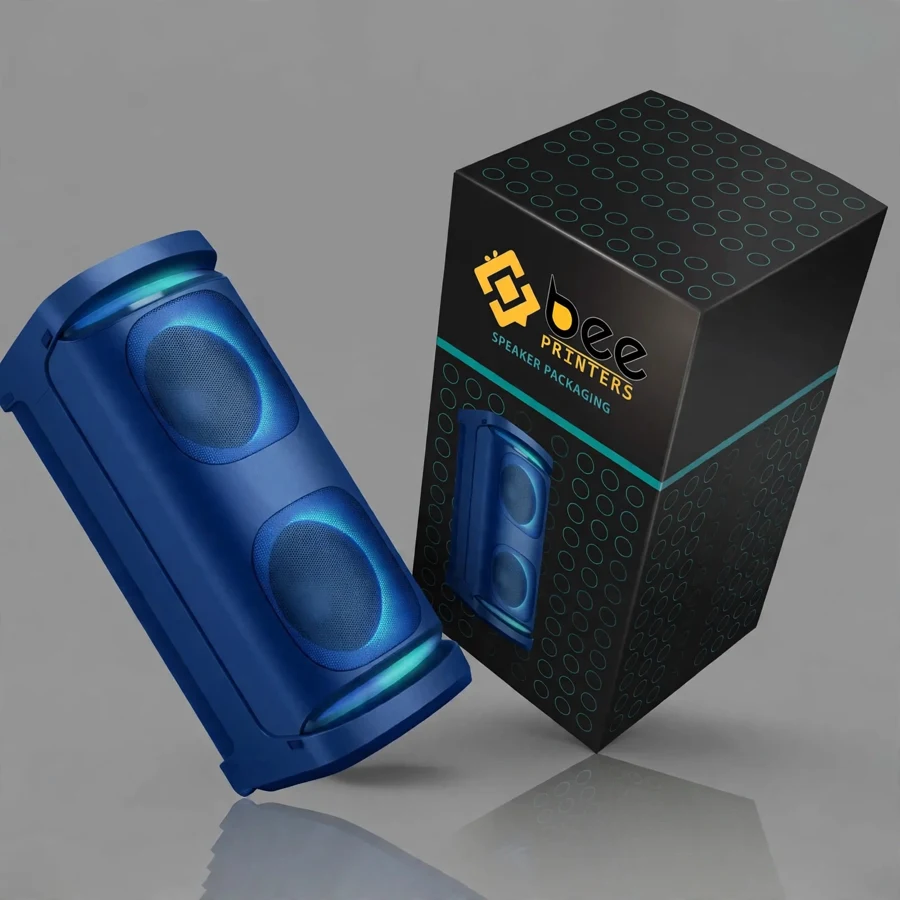
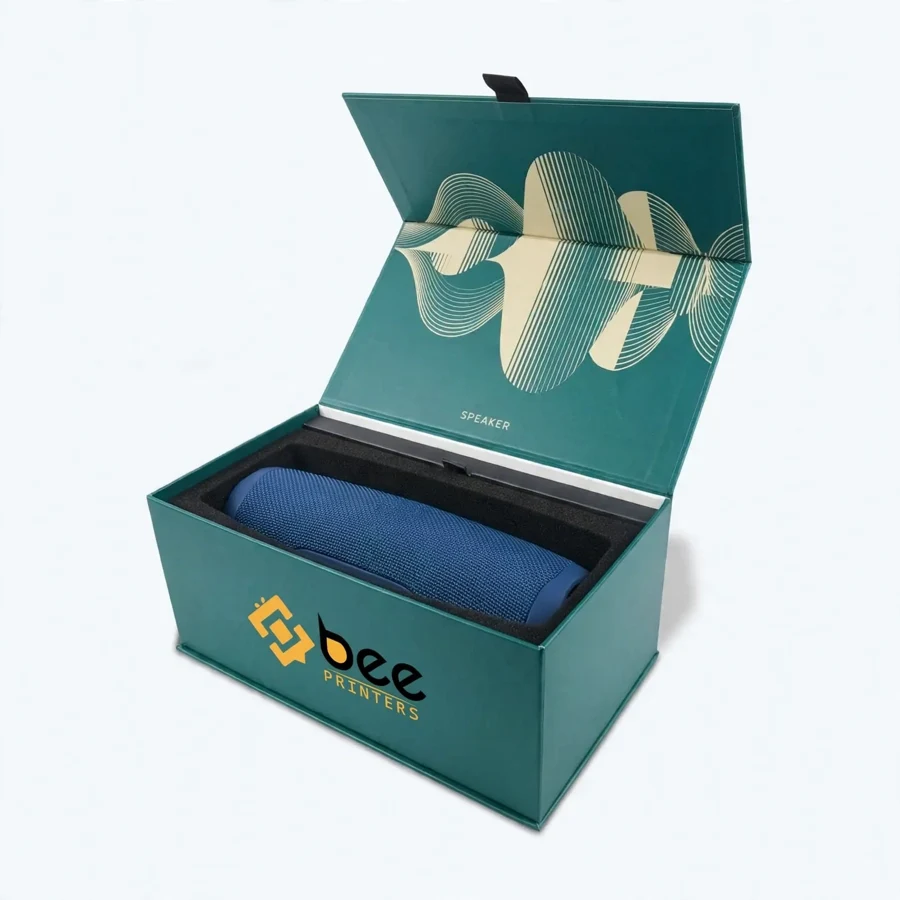
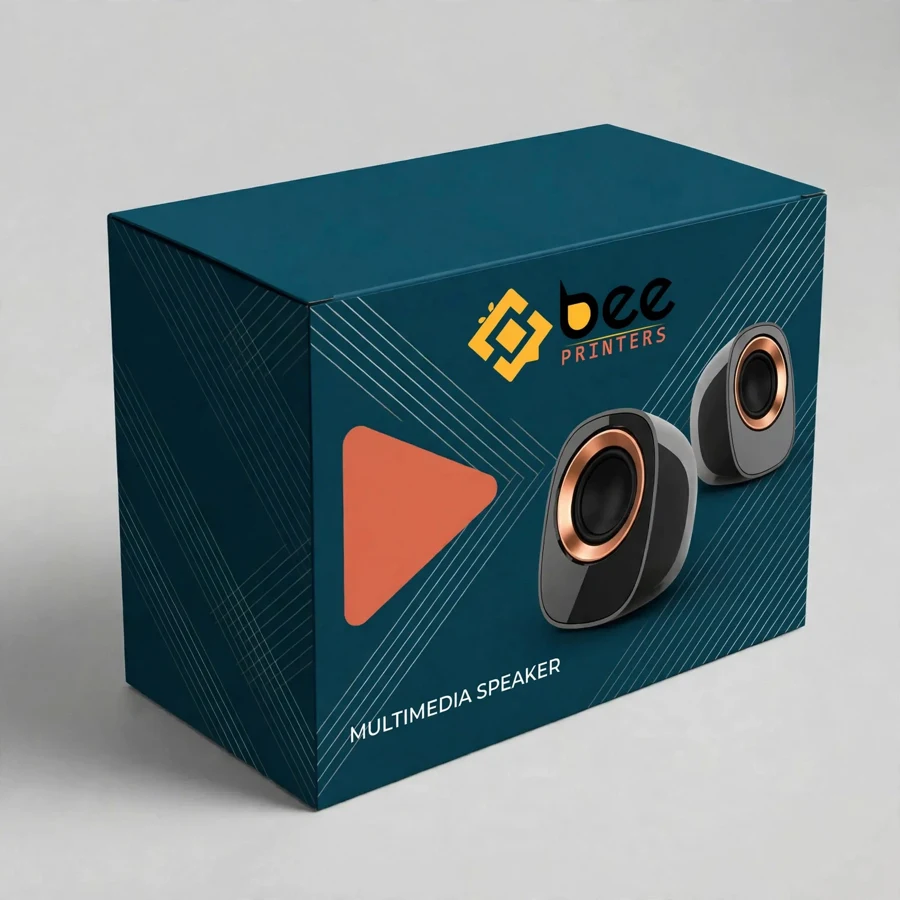
A speaker is a product people buy with their ears, but they choose it with their eyes — and the first thing they see is the box. Bee Printers makes custom speaker packaging boxes that protect audio equipment through shipping and storage, present it properly on a retail shelf, and carry your brand with a printed logo. Speakers range from small portable models to larger home units, and their packaging has to handle weight, shape, and a certain amount of fragility: drivers, grilles, and controls that should arrive exactly as they left the factory. A well-made box with the right insert does that, and it also makes the unboxing feel like part of the product.
Speakers are heavier and more delicate than they look. A portable speaker is dense, a bookshelf speaker is bulky, and both have parts that do not tolerate hard knocks: the driver cone, the grille fabric, and the control buttons or dials. Damage rarely comes from a single big impact; it comes from repeated small jolts during shipping, stacking, and handling. That is why speaker packaging uses a stronger board and a fitted insert rather than a plain carton. The insert holds the speaker in one position so it cannot shift, and the board absorbs the shocks that the insert cannot.
There is also a sales reason to take the box seriously. Speakers are a considered purchase, and buyers compare several models side by side before choosing. A box that looks solid and well printed signals a product that was made with care, while a thin or plain box raises doubts before the speaker is ever switched on. For retailers, a sturdy box also means fewer damaged returns and fewer display units that look tired after a week on the shelf.
Corrugated cardboard is the standard choice for speaker packaging because it combines strength with reasonable weight. A double-wall corrugated board suits larger or heavier speakers, while a single-wall board is enough for small portable models. Rigid chipboard is the premium option: it gives a solid, gift-box feel and holds its shape under stacking, which suits high-end home speakers and gift editions. Kraft board offers a simple, natural look that works well for brands with a minimal or eco-conscious presentation. Whatever the outer material, the inside matters just as much: a foam insert or a die-cut cardboard insert cradles the speaker, keeps the grille clear of the box walls, and holds accessories — a charging cable, an aux cable, a quick-start guide — in their own compartments.
Foam inserts are the most protective option. They can be cut to the exact shape of the speaker, including recesses for controls and ports, so the product sits snugly and cannot rotate or slide. Die-cut cardboard inserts are lighter and fully paper-based, and they suit brands that want the whole package to be recyclable in one stream. Some boxes combine the two: a cardboard tray for the accessories and a foam cradle for the speaker itself. The choice depends on the speaker’s weight, its shape, and how far it has to travel.
Tuck-end boxes are the practical choice for smaller speakers, especially portable models sold in large numbers through electronics retailers. They are cost-effective, easy to pack, and easy to display. Two-piece rigid boxes with a lift-off lid are the classic premium style, giving an unboxing experience that matches a higher price point; they are often used for home speakers and gift sets. Sleeve boxes, where a printed sleeve slides over an inner tray, combine a clean look with a satisfying opening action and work well for mid-range products. Mailer-style boxes with a self-seal flap suit speakers sold online, where the retail box doubles as the shipping box. For larger speakers, a corrugated shipping-style box with a printed outer and a fitted insert is the sensible option, because it is built to survive freight.
Handles and hanging features are worth considering for retail. A die-cut handle makes a heavier box easier to carry home, and a hang tab lets a small speaker box hang from a display hook rather than sitting on a shelf. Both are small details, but they affect how the product is displayed and how easily a customer takes it home.
Full-colour printing lets you put your logo, brand colours, product photography or illustration, and the key details of the speaker on the box. Most speaker brands keep the front of the box simple — a clean image of the product, the brand name, and one or two headline features — and put the fuller details on the back and side panels. Matte lamination gives a soft, premium feel and resists fingerprints; gloss lamination makes colours pop and protects the print from scuffs. Spot gloss can highlight a logo or a product name, and embossing adds a tactile detail that suits premium lines. Keep the design consistent with the rest of your range, so customers recognise your brand across different products.
Think about what a buyer needs to know before they pick the box up. The speaker’s size and shape are obvious from the image, but the details that help a decision — what it connects to, how it is powered, what is in the box — belong on the back panel in clear, plain language. A box that answers those questions without fuss sells better than one that hides them in small print.
Measure the speaker at its widest and tallest points, including any feet, handles, or protruding controls, then measure the accessories that travel with it. Add a small allowance for the insert and for the thickness of the board itself. A box that fits tightly is cheaper to ship and looks better on the shelf, but it must still be easy to pack at the warehouse — a box that fights the packer slows everything down and risks torn seams. If you sell several speaker sizes, it is usually better to size each box to its product rather than forcing different speakers into one shared box, because a loose fit is where most transit damage starts.
Audio brands selling through electronics retailers are the main buyers, and they usually order in large runs with consistent artwork across the range. Online audio sellers use printed boxes that double as shipping packs, cutting out a second layer of packaging. Corporate and event buyers order branded speakers as gifts, where the box turns a useful gadget into a present. Retailers with their own-label speakers use custom boxes to keep their range looking consistent. In every case, the packaging has to survive the journey from factory to shelf to home, and it has to look like it belongs to the brand printed on it.
Speaker packaging is ordered wholesale, and the unit price improves with quantity, so it pays to plan the run around real sales rather than guesswork. Start with the speaker’s measurements and a list of what goes in the box, choose a material and a style, and finalise the artwork. You can compare options across our Electronic Boxes range to see how different styles and boards look before you commit. Smaller runs are useful for a new product launch or a limited edition, while larger runs suit established models with steady demand. Allow time for a sample if the speaker is unusually shaped or heavy, because a fitted insert is worth checking against the real product before a full run is printed.
Well-planned packaging also helps the rest of the operation. A box that stacks neatly takes up less warehouse space and ships in fewer cartons. A box that is easy to assemble speeds up the packing line. And a box that protects the speaker properly cuts the cost of damaged returns, which is the most expensive packaging failure of all. Those savings are easy to overlook when ordering, but they are real, and they come from getting the structure right at the start.
Most audio brands sell more than one product — speakers, headphones, earbuds, cables — and customers notice when the packaging matches. The same print style, the same board, and the same approach to inserts can run across the whole range, so a customer who buys one product recognises the next. Our Headphone Packaging Boxes use the same printing and material options as our speaker boxes, so the two can sit together on a shelf as one clear brand. When you are ready to order, bring the speaker’s measurements, your logo files, and a note about where the speakers will be sold, and the box can be built around the product rather than the other way around.
| Material | Kraft, Cardboard, Corrugated, Rigid stock |
| Sizes | All custom sizes (any length × width × height) |
| Printing | CMYK / PMS, full-color, offset & digital |
| Finishing | Matte, Gloss, Soft-touch, Foil, Spot UV, Embossing |
| Add-ons | Window cut-outs, inserts, interior printing |
| Minimum Order | 100 boxes |
| Turnaround | 7 to 10 business days after design approval |
| Shipping | Free shipping across the US |