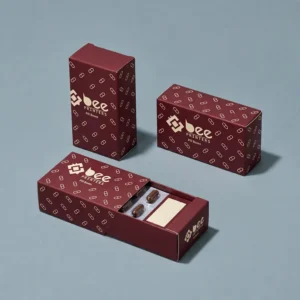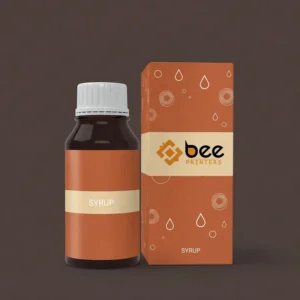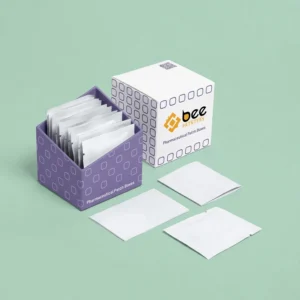
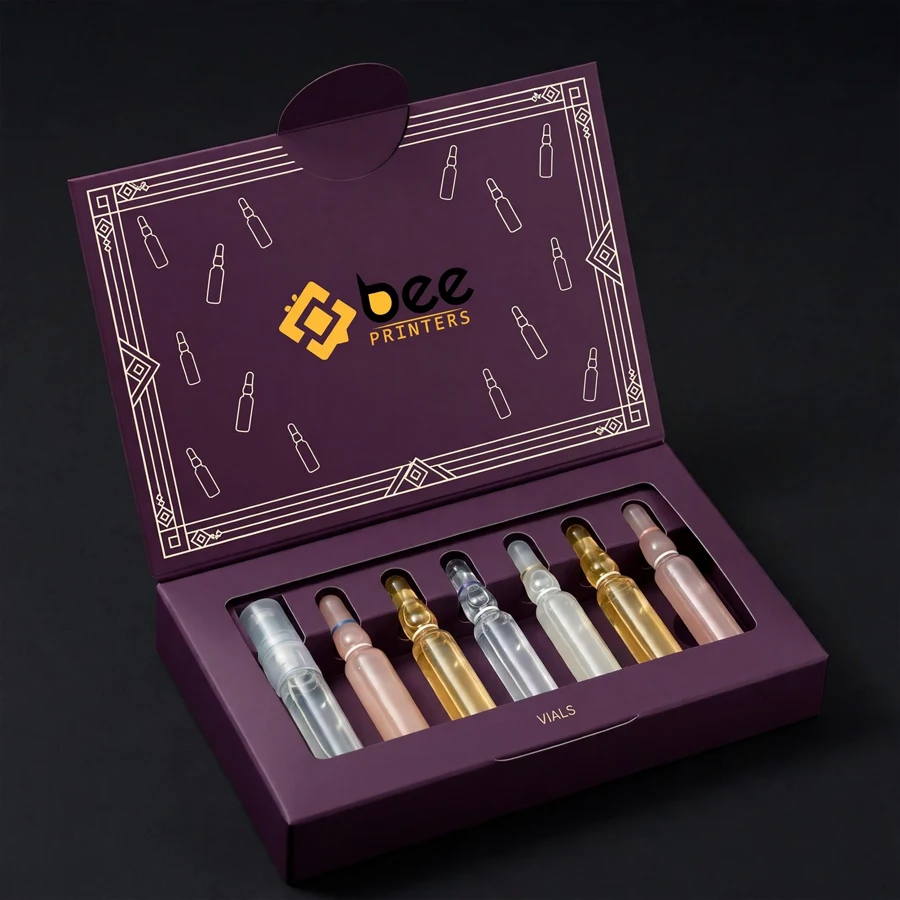
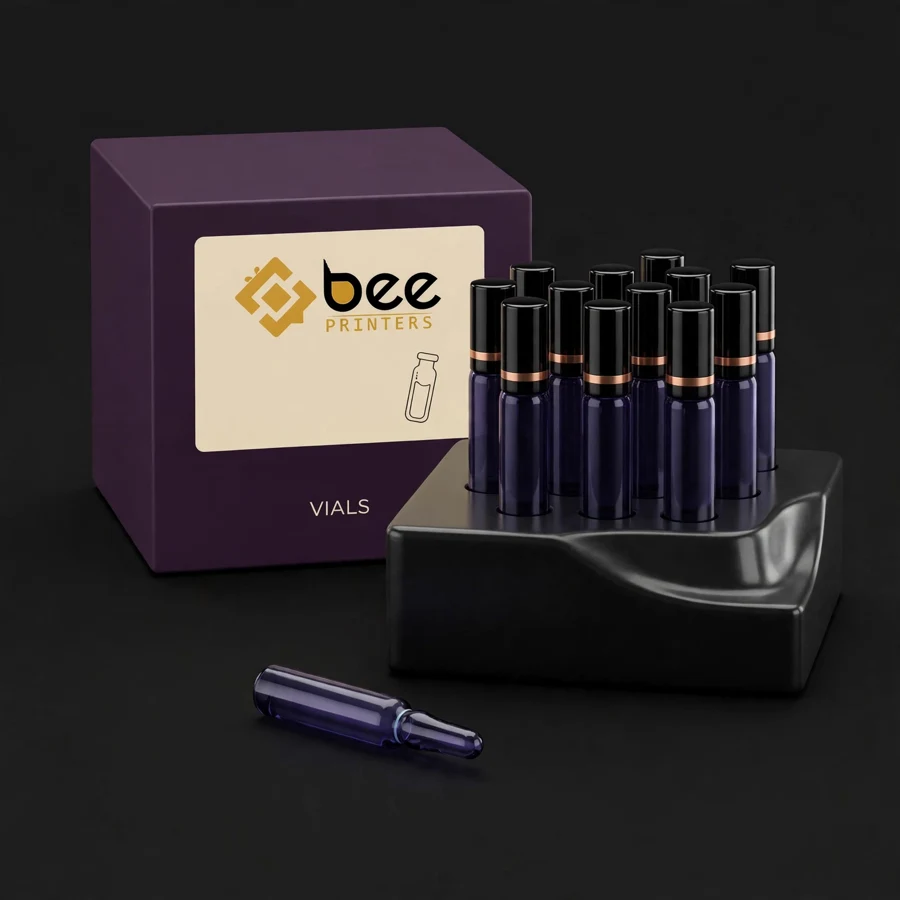
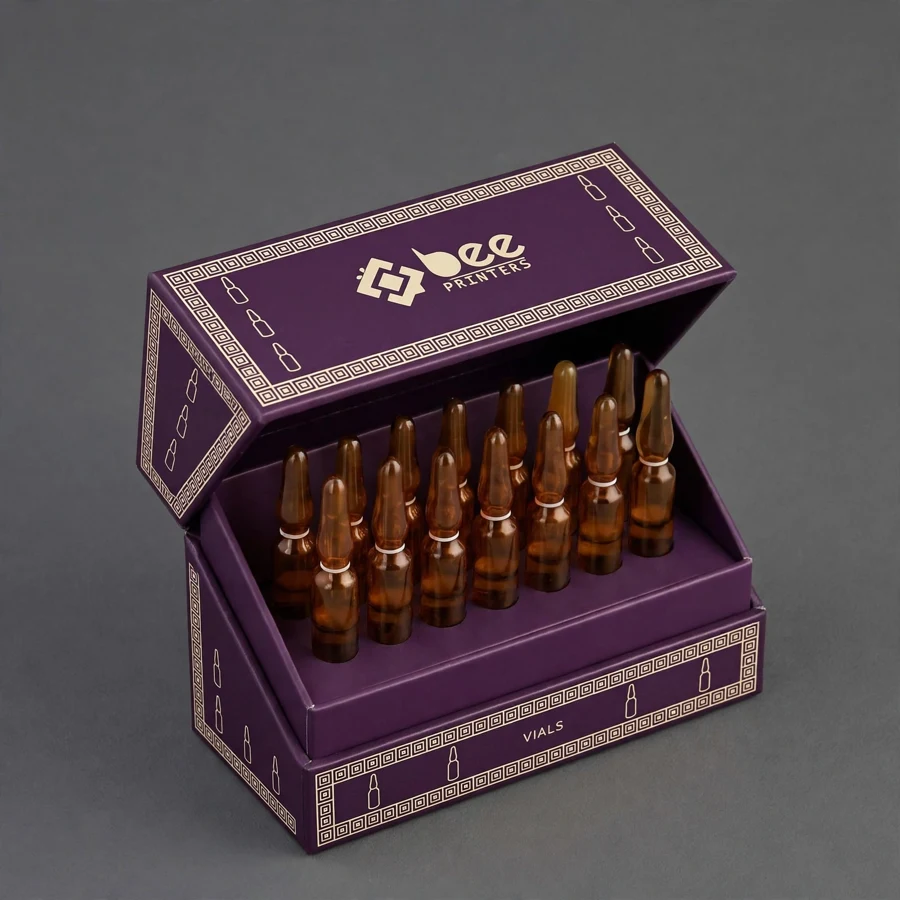
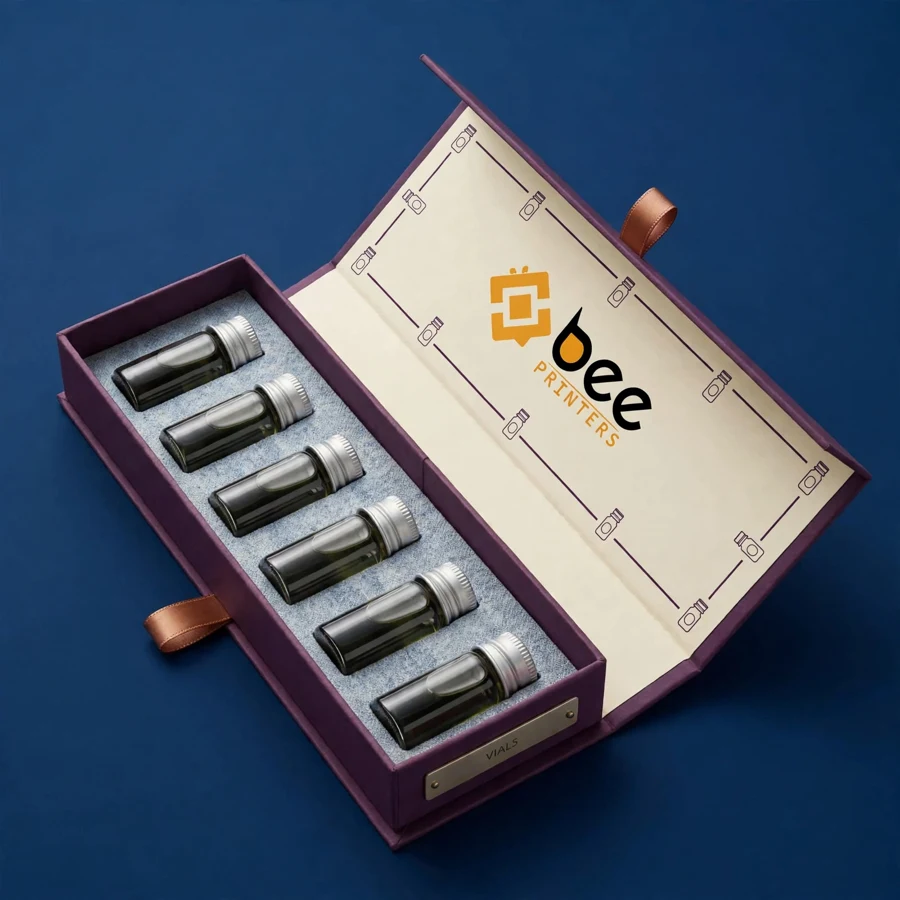
Small glass vials need packaging that fits them precisely. A vial that rattles around in an oversized box can chip, crack or lose its label, and a box that is too tight can be hard to open without forcing it. Custom vial boxes are built around the vial itself, with custom sizes for 2ml, 3ml and 10ml vials and a close-fitting print layout that keeps the vial secure and the box looking neat. At Bee Printers, each vial box is made from durable board, printed with the brand’s artwork and dimensioned so the vial sits exactly where it should.
The vial box is a small carton with a demanding job. It must protect a fragile glass container, present it clearly, carry the information that belongs with it, and stack neatly for storage and shipping. Because the box is custom sized, the vial does not shift during handling, the printed panels stay flat, and the carton keeps its shape from the packing line to the end user. That precision is the difference between a generic small box and packaging made for vials.
The defining feature of a vial box is its fit. A 2ml vial is a slim, short container; a 10ml vial is noticeably taller and wider, and each size needs its own carton dimensions. When the box is built around the vial’s height and diameter, with just enough clearance for easy insertion, the vial stays upright and centered. It does not lean against one wall, it does not tip when the box is set down, and it does not press against the flaps when the carton closes.
Close-fitting print is part of the same idea. The artwork, labels and text are laid out for the exact panel sizes of the chosen carton, so nothing important falls on a fold line or wraps around an edge where it cannot be read. The brand mark sits centered on the front panel, the size or volume sits where it is easy to find, and any code or batch area is placed on a flat surface. The result is a small box that looks considered rather than improvised, which matters when the vial inside is a product a customer has chosen carefully.
Glass vials are fragile, so the box around them has to be dependable. The durable design of a custom vial box starts with the board: a folding carton stock firm enough to hold its shape under stacking and handling, yet light enough to fold cleanly and keep shipping weight low. The tuck-end structure closes securely at both ends, and the scores are placed so the carton folds square every time, with no twisted panels or gaps at the corners.
Durability also shows up in the details. A well-made vial box resists crushing when cartons are stacked in a shipping case, and its flaps stay closed through the small knocks of warehouse handling. The board’s surface takes lamination well, which adds scuff resistance so the printed artwork still looks clean after the box has been stored, shipped and shelved. For brands that ship vials directly to customers, that toughness is what keeps the product arriving in the condition the customer expects.
Even a small vial box carries a surprising amount of printed information. The front panel holds the brand and the product name. The side panels hold the volume, the contents and the directions. The back panel can carry a barcode, a batch code area or a short brand message. Because the carton is printed flat before folding, the layout can be planned panel by panel so each piece of information sits on a flat, readable surface.
Full-color printing reproduces brand colors accurately and keeps the artwork consistent across a whole run, so a 2ml box and a 10ml box from the same range look like they belong together. Logos print sharply at small sizes, and text stays legible because the type is sized for the panel it sits on. For ranges with several vial sizes or several products, the same artwork family can run across all of them with the volume and product name changed per variant, which keeps the shelf or storage display consistent.
While 2ml, 3ml and 10ml are the common vial sizes, not every vial follows them. Some vials are shorter and wider, some are taller and slimmer, and some have caps or closures that add height beyond the glass itself. Custom sizing covers all of these, because the carton is dimensioned from the actual vial rather than from a standard template. The height, width and depth are set from the vial’s measurements, including the cap, so the finished box fits the real product rather than an approximation of it.
Custom sizes also help with inserts and dividers. A vial box can be fitted with a simple cardboard insert that holds the vial centered, or a divider that separates two vials in one carton. These are small additions, but they make a real difference to how secure the vial feels inside the box and how neatly the box presents when it is opened. The insert is cut to the same measurements as the carton, so everything fits together without forcing.
Vial boxes are ordered by a wide mix of businesses, and they all need the same thing: a small, precise carton that protects glass and presents it well. Laboratories order them for sample and reagent vials that must travel between sites. Cosmetic and fragrance brands order them for small bottles and sample vials that are sold or given away with larger products. Supplement and wellness brands order them for small-volume products that need a carton sized to the vial rather than to a generic small box.
Retailers order them too, because a vial on a shelf without a box is hard to display, hard to label and easy to knock over. A boxed vial stands upright, stacks in rows and carries its own printed information, which makes it far easier to merchandise. The same carton works for storage, shipping and display, so one order covers the whole journey. Explore the wider pharmaceutical packaging range to compare vial boxes with the other small cartons built for the same kind of product.
Vial boxes are usually ordered in volume, and wholesale pricing reflects that. Larger quantities bring the unit cost down, and running the same artwork family across 2ml, 3ml and 10ml sizes keeps pre-press work efficient. Low minimums let a small brand start with a single vial size, while wholesale programs support the volume of a full range.
Ordering starts with the vial itself: its volume, its height and diameter, and the style of its cap or closure. Free design support helps turn brand artwork into a print-ready layout for the small panels, and free US shipping keeps the landed cost predictable. Brands that already order other small printed cartons will find the process familiar; Custom Soap Boxes follow the same custom sizing and printing process, so adding vial boxes to an existing packaging range is straightforward. Share the vial size, the artwork and the quantity, and a specification and quote follow from there.
The standard sizes are 2ml, 3ml and 10ml, and custom sizes are available for any vial height and diameter, including vials with taller caps or closures.
Yes. The full exterior can be printed in full color with brand colors, logos, product names, volumes and barcodes placed panel by panel.
Yes. A cardboard insert or divider can be fitted inside the carton to keep the vial centered and secure during storage and shipping.
Yes. Wholesale pricing applies to larger quantities, and consistent artwork across vial sizes keeps the unit cost down as volume grows.
| Material | Kraft, Cardboard, Corrugated, Rigid stock |
| Sizes | All custom sizes (any length × width × height) |
| Printing | CMYK / PMS, full-color, offset & digital |
| Finishing | Matte, Gloss, Soft-touch, Foil, Spot UV, Embossing |
| Add-ons | Window cut-outs, inserts, interior printing |
| Minimum Order | 100 boxes |
| Turnaround | 7 to 10 business days after design approval |
| Shipping | Free shipping across the US |