
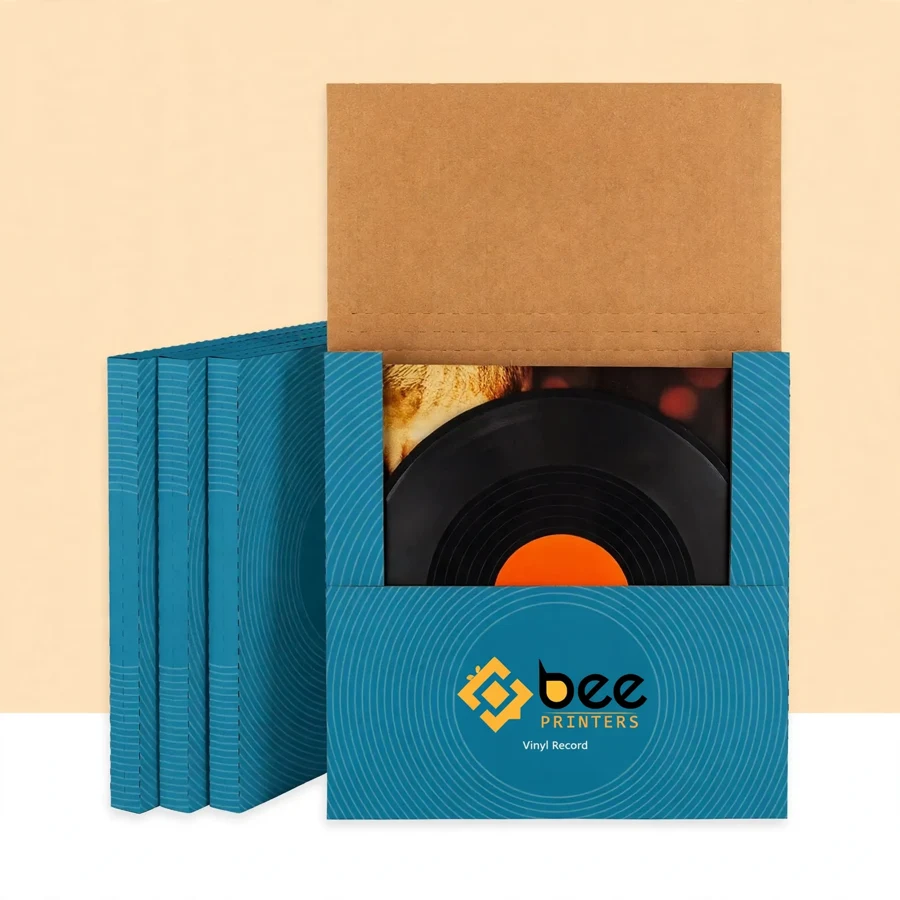
A vinyl record is more than a way to play music. It is a physical object people collect, display, and keep for years, and the packaging around it is part of that experience. A well-made vinyl record sleeve or jacket protects the disc from dust, scratches, and bending, while giving the release a look that belongs on a shelf or in a record store bin. At Bee Printers, vinyl record packaging is printed to fit the format, with sturdy board, clean print, and a finish that holds up to handling, shipping, and repeated browsing.
Record packaging comes in several familiar forms. The classic single-pocket jacket holds a 12-inch LP with an inner sleeve, while a gatefold jacket opens out to give extra space for artwork, notes, and photographs. Seven-inch singles use smaller sleeves, and record mailers are rigid corrugated boxes built for posting a record safely. Each format serves a different purpose, and choosing the right one depends on how the record will be sold, stored, and shipped. Our retail boxes range covers the shelf-ready formats collectors and shops rely on, from simple printed sleeves to sturdier jackets.
The 12-inch LP jacket is the standard most buyers picture when they think of vinyl. It is a square sleeve, roughly 12 inches on each side, made from printed cardstock thick enough to keep its shape. The front carries the cover artwork, the back carries the track list and credits, and the spine carries the title so the record can be found when it is filed upright. A printed inner sleeve sits inside the jacket, holding the disc itself and keeping it away from the printed board. Some releases add a poly-lined inner sleeve for extra protection against scuffs, and some use a printed inner with lyrics or photographs. The jacket is the first thing a buyer touches, so its weight, print quality, and finish all shape the impression the release makes.
Gatefold jackets fold open like a book, doubling the printable area. They suit double albums, where two discs need room, and releases where the artwork or the story behind the music deserves more space. A gatefold can carry a full spread of photography, a printed essay, or the complete lyrics, and it feels substantial in the hand. Because gatefolds use more board and more print, they cost more than a single-pocket jacket, but for a special release the extra presence is often worth it. The fold itself must be scored cleanly so it opens flat and closes neatly, and the pockets must hold the discs without letting them slip out when the jacket is opened.
Seven-inch singles and EPs use a smaller sleeve, usually a simple pocket or a picture sleeve printed on both sides. These are often sold at gigs, in shops, or by mail, and their small size makes them easy to display in racks or to slip into a mailer. Some singles come with a printed centre label area and a plain inner sleeve, while others use a full-colour picture sleeve as the main selling point. The print on a small sleeve has to work harder, because there is less room for the title, the artist name, and the track details, so clean typography matters.
Record jackets are usually printed on coated or uncoated cardstock in the 300 to 400 gsm range, thick enough to resist bending but light enough to keep shipping costs down. Uncoated board gives a matte, paper-like feel that suits a stripped-back design, while coated board gives sharper colour and a smoother surface. Kraft board is another option, with a natural brown tone that works well for a handmade or vintage look. The choice of board affects how the colours print, how the jacket feels, and how it ages on a shelf, so it is worth matching the material to the design rather than picking it as an afterthought.
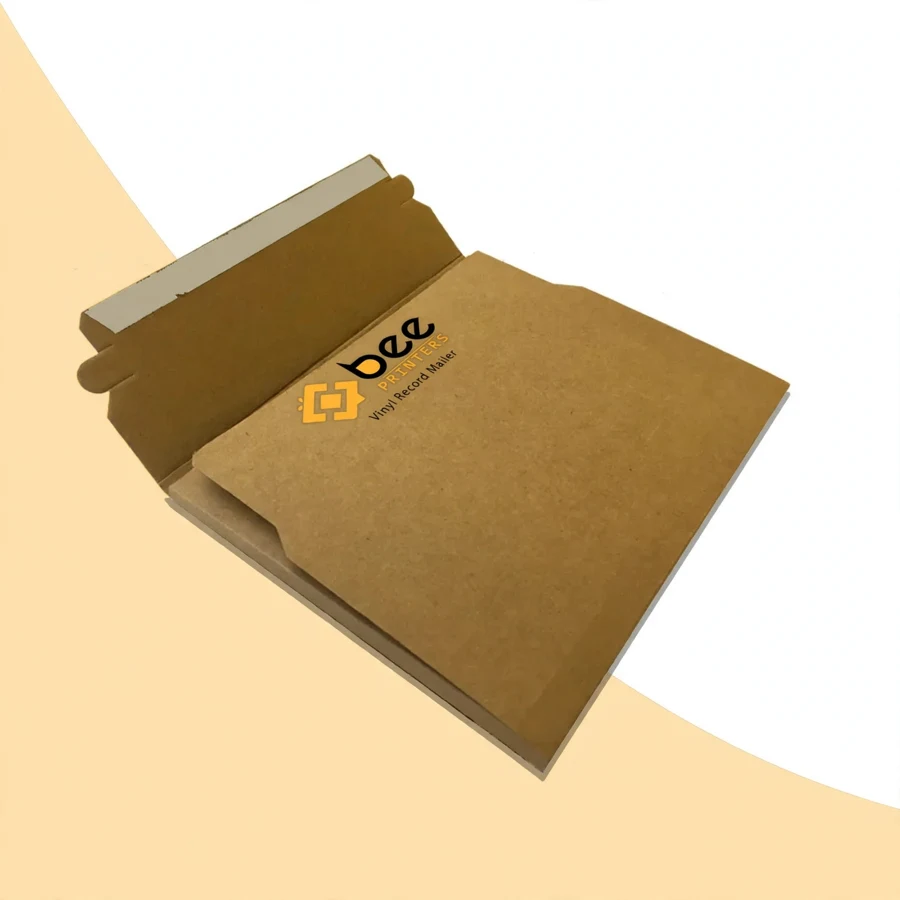
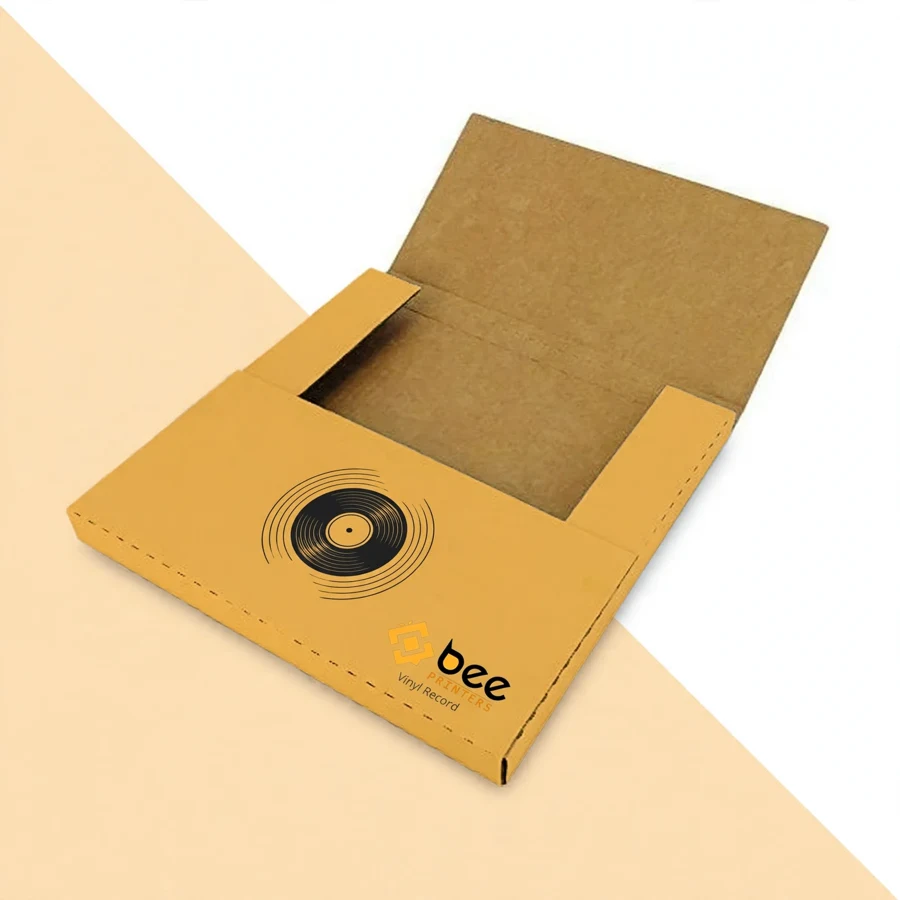
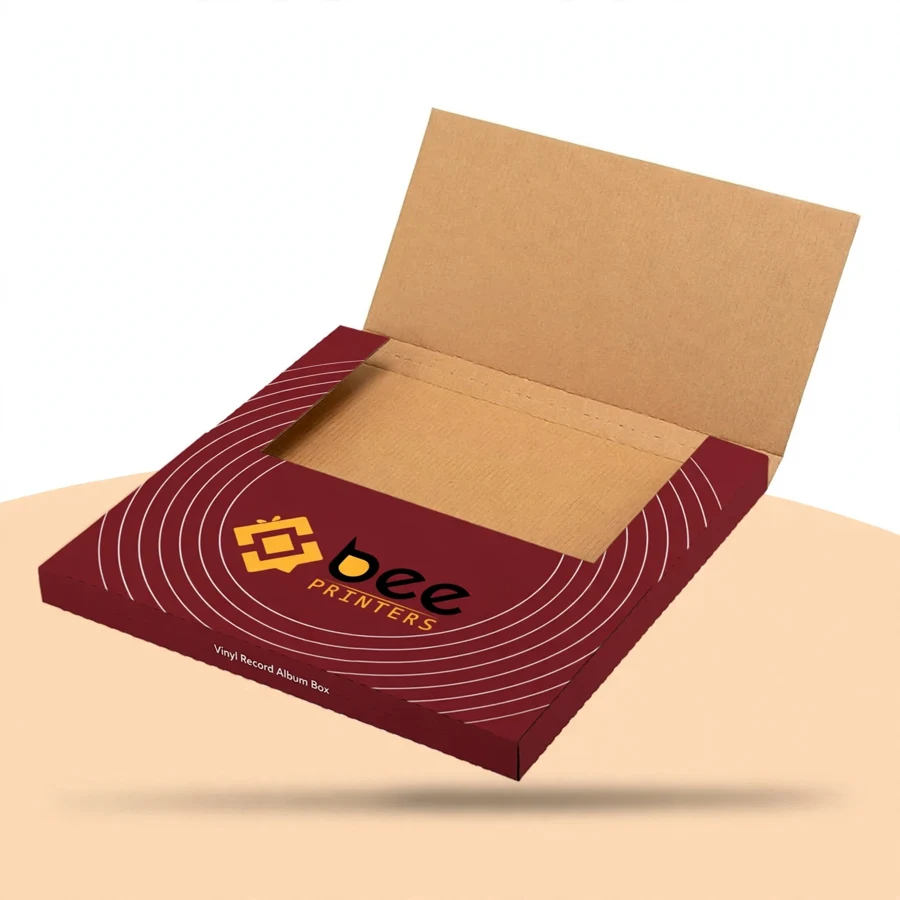
Record mailers are a different kind of packaging altogether. They are made from corrugated board, scored and folded to hold one or more records flat, with flaps that lock the disc in place so it cannot slide around in transit. A good mailer protects the corners of the jacket, which are the first thing to get crushed in the post, and it keeps the record flat so it cannot warp. Mailers are usually plain on the outside, but they can be printed with a logo or a return address, and they can be sized for a single LP, a double LP, or a small stack of singles. For anyone selling records online, the mailer is as important as the jacket itself.
Full-colour CMYK printing is the standard for record jackets, reproducing cover artwork, photographs, and illustrations across the front, back, and spine. Spot colours can be used where a precise brand colour matters, and a matte or gloss lamination protects the print from fingerprints and scuffs. Soft-touch lamination gives a velvety feel that suits a premium release, while a gloss finish makes colours look richer and more vivid. Foil stamping, embossing, and spot UV are available for covers that need a detail to stand out, such as a logo or a title, but they work best when used sparingly on a design that is already strong.
The spine is the smallest part of the jacket and one of the most important. It carries the title and the artist name in type large enough to read from a distance, so the record can be found in a crate or on a shelf. Spine text must be set accurately, because a jacket that is a fraction of a millimetre off can push the text onto the front or the back panel. The same care applies to the back cover, where the track list, credits, and any barcode sit. A barcode needs a clear, unprinted area around it so it scans cleanly at the till, and the track list needs to be legible at a small size.
Inner sleeves do the quiet work of protecting the disc. A plain paper inner sleeve is the simplest option, while a poly-lined paper sleeve adds a smooth plastic layer that reduces friction and keeps dust off the grooves. Printed inner sleeves carry lyrics, photographs, or artwork, turning a protective layer into part of the release. Some releases use a clear plastic outer sleeve as well, a loose cover that keeps the jacket clean while the record is on display or in storage. Outer sleeves are popular with collectors, because they keep the jacket looking new without hiding the artwork.
Record shops need packaging that survives constant browsing. Jackets are pulled in and out of bins all day, so the board must resist creasing and the print must resist wear. A laminated jacket lasts longer under that kind of handling, and a sturdy spine keeps the jacket standing upright in a full bin. Labels and independent sellers need packaging that works for small runs as well as large ones, with consistent print quality across the order and reliable sizing so every jacket fits the disc it is made for. Online sellers add another requirement: the jacket must fit inside a mailer without being squeezed, and the mailer must fit inside the postal service’s size and weight limits.
Display matters too. A record that is going to be shown in a shop window or at a market stall benefits from a jacket with a strong front image and a spine that reads clearly. Counter displays and browser boxes can hold a selection of titles face-out, and a printed header card can mark a section or a new release. Pairing the jacket with a matching display piece gives the release a presence that a single sleeve on its own cannot match, and it helps a shop organise its stock so customers can find what they are looking for. For a related shelf-ready option, see our retail display boxes, which suit counter and floor displays for packaged goods.
When you order vinyl record packaging, it helps to know the format, the quantity, and the artwork you want printed. A 12-inch LP jacket, a gatefold, a 7-inch sleeve, and a record mailer are all different products, and each one is sized and scored for its format. Quantities can range from a short run for a single release to a larger order for a catalogue or a shop’s house stock, and the print files need to include bleed and a spine allowance so the artwork wraps correctly. A proof lets you check the colours, the spine text, and the fold before the full run is printed, which is the simplest way to avoid a costly mistake.
Vinyl record packaging works best when it is planned as part of the release, not added at the end. The jacket, the inner sleeve, and the mailer all protect the disc, and together they present the music in a way that a plain sleeve never could. Whether the record is a new release, a reissue, or a small run sold at gigs, the right packaging keeps it safe in transit, easy to find on a shelf, and worth keeping long after the music has been played.
| Material | Kraft, Cardboard, Corrugated, Rigid stock |
| Sizes | All custom sizes (any length × width × height) |
| Printing | CMYK / PMS, full-color, offset & digital |
| Finishing | Matte, Gloss, Soft-touch, Foil, Spot UV, Embossing |
| Add-ons | Window cut-outs, inserts, interior printing |
| Minimum Order | 100 boxes |
| Turnaround | 7 to 10 business days after design approval |
| Shipping | Free shipping across the US |


