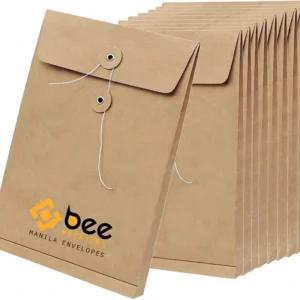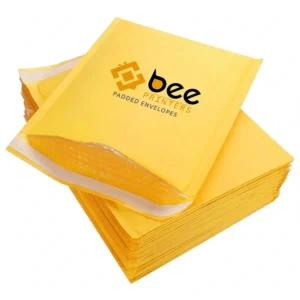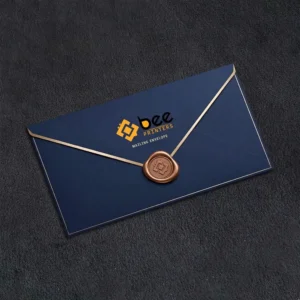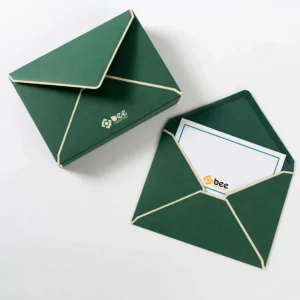
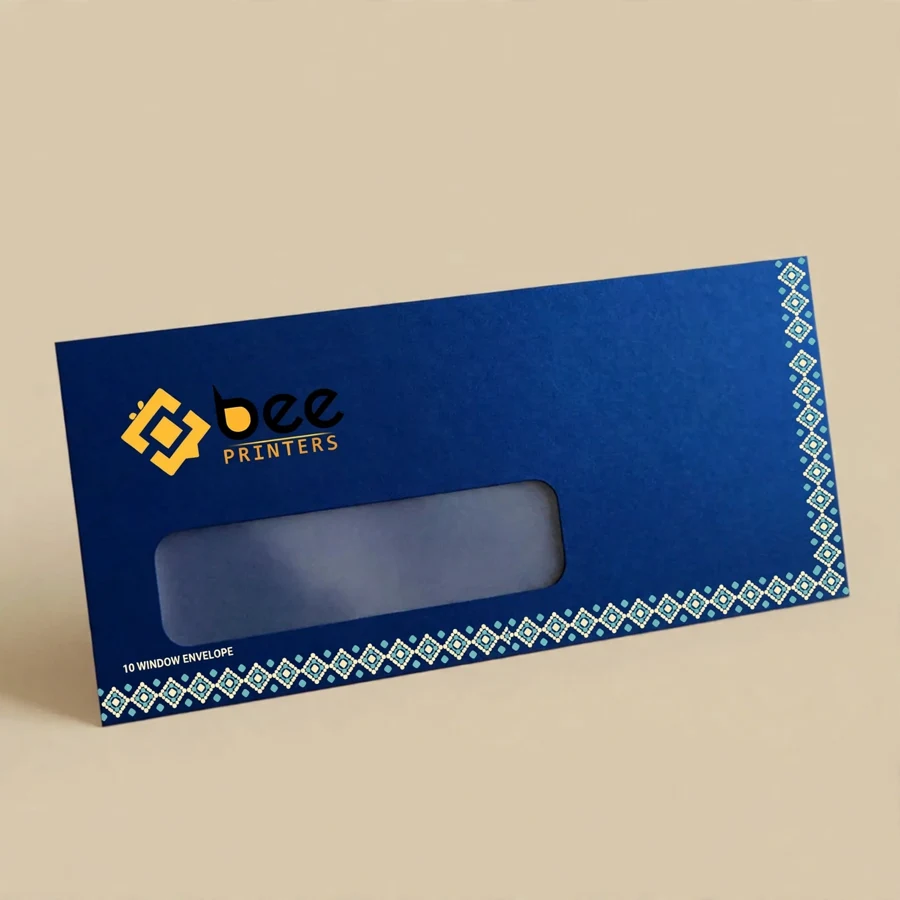
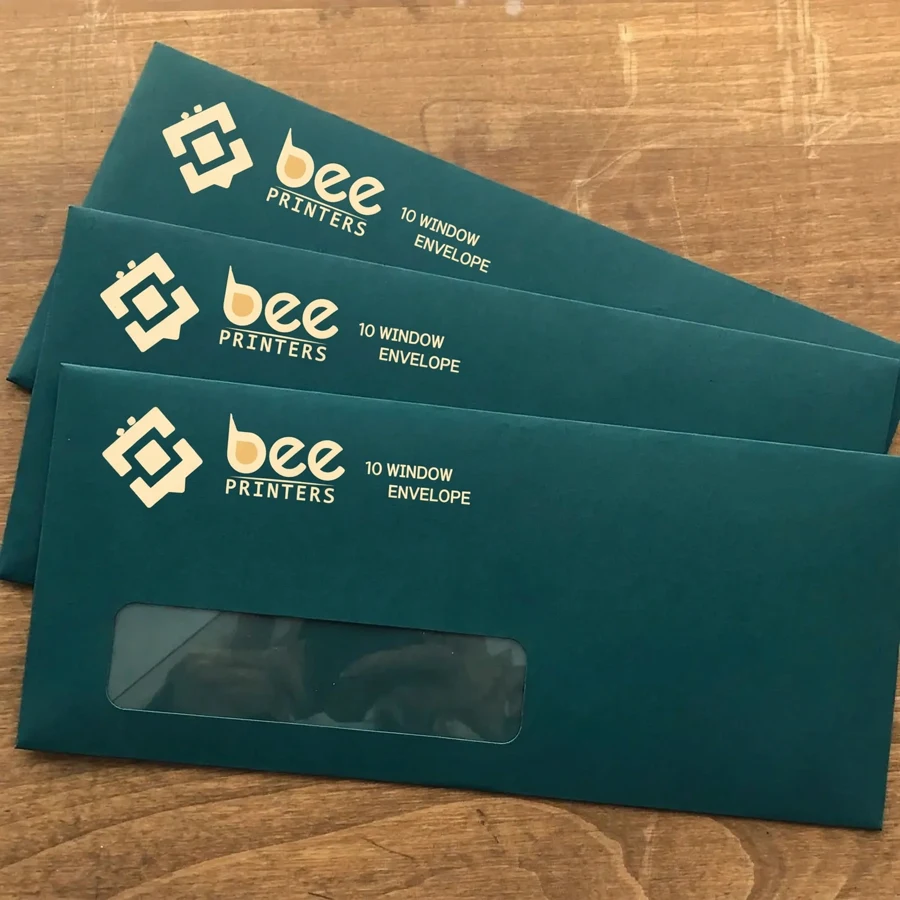
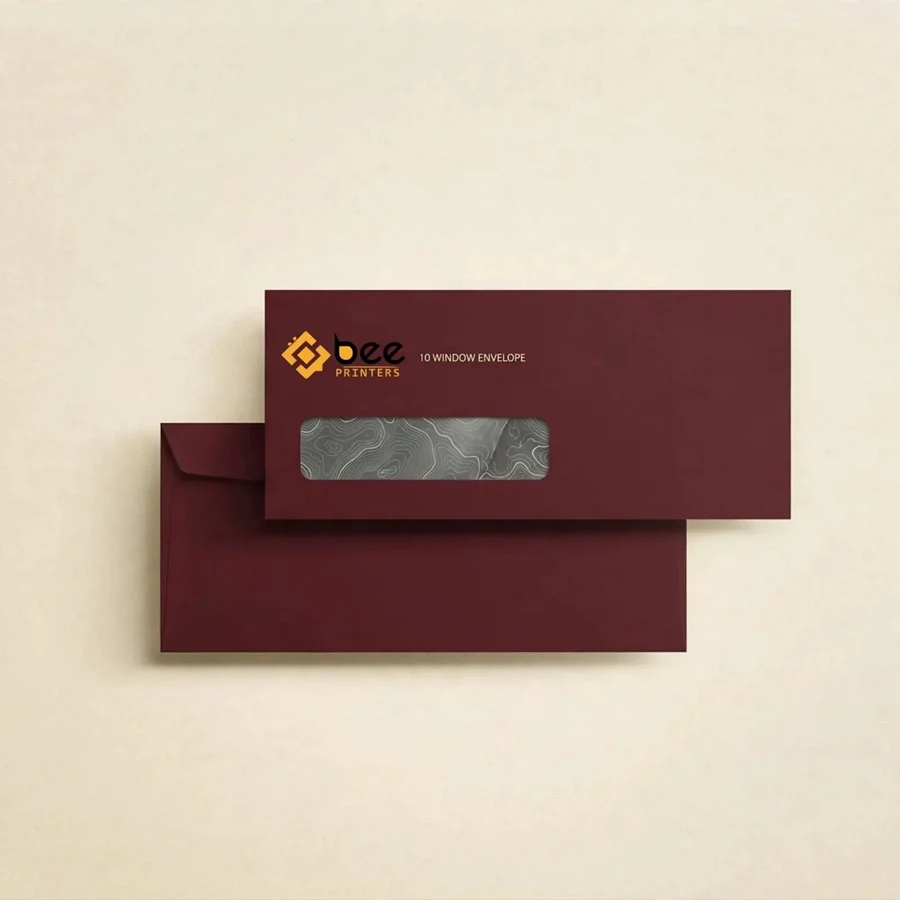
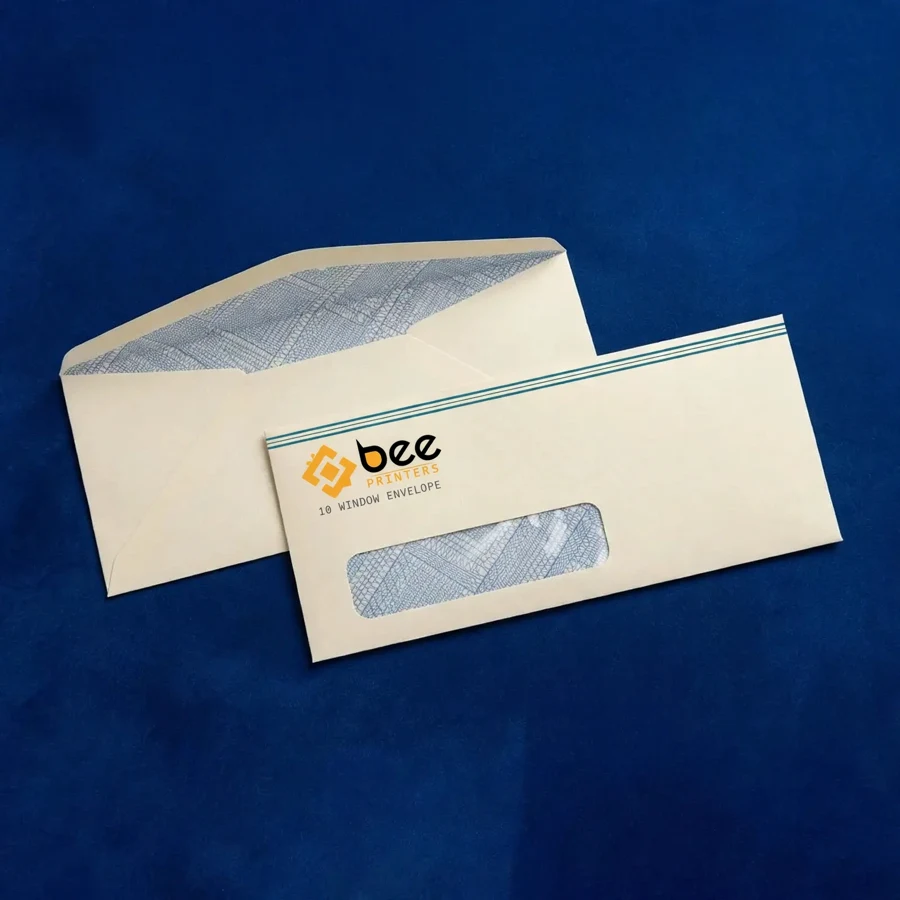
A window envelope saves a step that every busy office knows well: writing or printing an address on the outside of the envelope when the letter inside already carries it. Bee Printers supplies custom #10 window envelopes in the standard 4⅛ by 9½ inch size, with a clear window that shows the recipient’s address, self-seal flaps for fast sealing, and security tinting to keep the contents private. They are the standard choice for invoices, statements, and any business mail that is prepared in volume, because they cut out the addressing step, reduce errors, and keep the whole mailing process moving.
A #10 window envelope is a standard #10 business envelope with a transparent panel cut into the front. The letter inside is folded so that the recipient’s name and address line up with the window, and the address shows through clearly. The window is usually placed on the lower left of the envelope front, in the position that mailing equipment and postal systems expect, and it is made from a clear film that stays flat and transparent in normal handling. Because the address is printed on the letter itself, there is no separate label to print, stick, or align — the envelope and the letter are prepared as one job.
The standard size is the same as a regular #10: 4⅛ by 9½ inches, sized for a standard letter sheet folded in three. That means a window envelope fits the same paper, the same trays, and the same inserting machines as a plain #10, and it can be used interchangeably in an office that already stocks #10 envelopes. The only difference is the window — and the time it saves.
The biggest advantage is accuracy. When the address is printed on the letter and shown through the window, there is no chance of the envelope and the letter getting mismatched, which is a real risk when addresses are printed or written separately. For a business sending hundreds of invoices or statements, that accuracy matters: a letter that goes to the wrong address is a payment delayed, a customer confused, or a piece of private information sent to the wrong person. Window envelopes remove that risk by making the letter and the envelope a single unit.
Speed is the second advantage. Addressing an envelope by hand or by label takes time, and in a high-volume mailing that time adds up. With a window envelope, the addressing happens once, when the letter is printed, and the stuffing is the only remaining step. Mailing houses and offices that process mail in bulk rely on this: a window envelope works with automatic inserting machines, which fold the letter, slide it into the envelope, and seal it in one pass. That is why window envelopes are the default for utility bills, bank statements, insurance letters, and invoices of every kind.
Most #10 window envelopes come with a self-seal flap: a peel-off strip that reveals an adhesive, so the envelope closes with a firm press and no moisture. In a high-volume mailing, self-seal is noticeably faster than a gummed flap, because the person sealing the envelope does not have to wet it, wait for it to stick, or press it for long. The seal is also consistent — every envelope closes the same way, with the same strength — which matters when envelopes are handled by a machine or stacked in a tray before posting. For offices that seal mail by hand, self-seal is cleaner and more comfortable, and it avoids the damp, sticky flaps that slow a mailing down.
The flap itself is usually on the long side of the envelope, in the standard commercial style, so the envelope opens and closes in the way that mailroom staff expect. A well-made self-seal flap stays flat in storage and seals firmly the first time, without curling or lifting at the corners.
Window envelopes carry letters that often contain private information — account numbers, balances, personal details — so privacy is built in. Security tinting is a pattern printed on the inside of the envelope that stops the contents from showing through the paper. The window itself only reveals the address block, which is positioned so that no other part of the letter is visible through it. That combination — a tinted body and a carefully placed window — keeps the letter private while the address stays readable.
It is worth checking the window position against your own letter template before ordering in bulk. The address block on your letter needs to sit exactly behind the window when the letter is folded, and different letter layouts fold differently. A quick test with a sample envelope and a folded letter confirms the alignment, and once it is confirmed, every envelope in the run works the same way.
#10 window envelopes are usually made from white wove paper in a standard 24 lb weight, which is strong enough for daily mail, light enough to keep postage down, and smooth enough to print cleanly. The outside can be printed with your logo and return address, usually in one or two colours in the top left corner, which is where recipients look for the sender. Full-colour printing is available for brands that want the envelope to match their stationery exactly. Keep the print simple and clear — the window and the address need space, and the branding should sit quietly in its corner rather than competing with them.
The paper quality also affects how the envelope runs through office equipment. A smooth, consistent paper feeds cleanly through printers and inserters, while a rough or uneven paper can jam or misfeed. That is a practical reason to order from a consistent supplier: every batch behaves the same way in your machines, and no one has to adjust the equipment for a new batch of envelopes.
Window envelopes are a bulk product, and the unit price improves with quantity, so offices and mailing houses order them by the thousand. Before ordering, confirm your letter layout against the window position, decide on self-seal or gummed flaps, and choose whether you need security tinting — for invoices and statements, you almost certainly do. You can compare sizes and styles across our full Envelopes range before deciding. Keep a steady stock on the shelf, stored flat and dry, and the envelopes will be ready whenever the next batch of letters is printed. A box of window envelopes takes up little space, and because the size is standard, a fresh order fits the same workflow as the last one.
For a business that sends the same kind of letter every month — invoices on the first, statements on the fifteenth, reminders as needed — a standing order of printed window envelopes removes a recurring chore. The envelopes arrive ready to use, the letters are printed with the address in the right place, and the mailing goes out without a separate addressing step at all.
Most businesses that use window envelopes also send other kinds of mail, and the window envelope is usually the one that goes out most often. Larger documents may need a bigger envelope, and small parcels need a padded mailer, but the everyday letter — the invoice, the statement, the notice — travels in a #10 window envelope. Keeping the branding consistent across the different formats makes every piece of mail recognisably yours. Our Book Mailers are a useful companion for the thicker items that do not fit a standard envelope, such as booklets and catalogues, and they can carry the same printed return address and logo. When you are ready to order, bring your logo file, your return address, and a sample of your letter layout, and your window envelopes can be printed and delivered ready for the next mailing.
| Material | Kraft, Cardboard, Corrugated, Rigid stock |
| Sizes | All custom sizes (any length × width × height) |
| Printing | CMYK / PMS, full-color, offset & digital |
| Finishing | Matte, Gloss, Soft-touch, Foil, Spot UV, Embossing |
| Add-ons | Window cut-outs, inserts, interior printing |
| Minimum Order | 100 boxes |
| Turnaround | 7 to 10 business days after design approval |
| Shipping | Free shipping across the US |